


Page 227 - New Medley 5 Semester 1
P. 227
5.  A rectangular stadium is of length 300 m and breadth 140 m. A gallery
                   of width 12 m is made all around the stadium for the viewers. Find the
                   expenses on the construction of the gallery at the rate of `10,000 per

                   sq m.
              6.  A square lawn is of side 60 m. There are four flowerbeds of size 4 m by

                   2 m in the middle and four square flowerbeds of size 4 m by 4 m at the four
                   corners. Calculate the cost of laying the grass in the lawn at the rate of
                   `500 per sq m.

                                                      Volume


        In  the  previous  sections,  we  discussed about  perimeter  and  area  which

        are  measures  of  the  boundary  (one  dimension–length)  and  surface  (two

        dimensions–length  by  width)  respectively.  In this  section,  we  shall  learn
        about volume which is the measure of space (three dimensions–length by
        width by depth or height).


        What is Space?

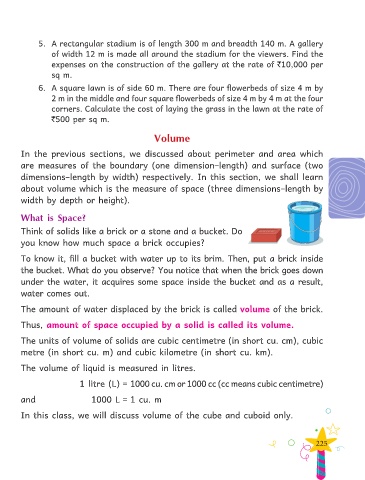
        Think of solids like a brick or a stone and a bucket. Do

        you know how much space a brick occupies?

        To know it, fill a bucket with water up to its brim. Then, put a brick inside

        the bucket. What do you observe? You notice that when the brick goes down
        under the water, it acquires some space inside the bucket and as a result,

        water comes out.

        The amount of water displaced by the brick is called volume of the brick.

        Thus, amount of space occupied by a solid is called its volume.


        The units of volume of solids are cubic centimetre (in short cu. cm), cubic
        metre (in short cu. m) and cubic kilometre (in short cu. km).


        The volume of liquid is measured in litres.

                             1 litre (L) = 1000 cu. cm or 1000 cc (cc means cubic centimetre)


        and                      1000 L = 1 cu. m

        In this class, we will discuss volume of the cube and cuboid only.


                                                                                                              225

