


Page 157 - New Medley 5 Semester 1
P. 157
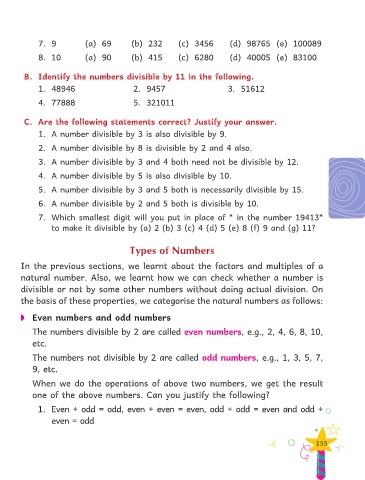
7.  9           (a)  69         (b)  232         (c)  3456        (d)  98765  (e)  100089

              8.  10          (a)  90         (b)  415         (c)  6280        (d)  40005  (e)  83100


         B.  Identify the numbers divisible by 11 in the following.
              1.  48946                        2.  9457                         3.  51612


              4.  77888                        5.  321011


         C.  Are the following statements correct? Justify your answer.
              1.  A number divisible by 3 is also divisible by 9.

              2.  A number divisible by 8 is divisible by 2 and 4 also.

              3.  A number divisible by 3 and 4 both need not be divisible by 12.

              4.  A number divisible by 5 is also divisible by 10.

              5.  A number divisible by 3 and 5 both is necessarily divisible by 15.

              6.  A number divisible by 2 and 5 both is divisible by 10.

              7.  Which  smallest  digit  will  you  put  in  place  of  *  in  the  number  19413*
                   to make it divisible by (a) 2 (b) 3 (c) 4 (d) 5 (e) 8 (f) 9 and (g) 11?


                                              Types of Numbers


        In  the  previous  sections,  we  learnt  about  the  factors  and  multiples  of  a
        natural  number.  Also,  we  learnt  how  we  can  check  whether  a  number  is

        divisible or not by some other numbers without doing actual division. On
        the basis of these properties, we categorise the natural numbers as follows:


          Z Z Even numbers and odd numbers

            The numbers divisible by 2 are called even numbers, e.g., 2, 4, 6, 8, 10,
            etc.

            The numbers not divisible by 2 are called odd numbers, e.g., 1, 3, 5, 7,

            9, etc.

            When  we  do  the  operations  of  above  two  numbers,  we  get  the  result
            one of the above numbers. Can you justify the following?


              1.  Even  +  odd  =  odd,  even  +  even  =  even,  odd  +  odd  =  even  and  odd  +
                   even = odd


                                                                                                              155

