


Page 159 - New Medley 5 Semester 1
P. 159
Z Z Now, circle all other uncrossed numbers.

            The circled numbers 2, 3, 5, 7, 11, 13, 17, 19, 23, 29, 31, 37, 41, 43,

            47,  53,  59,  61,  67,  71,  73,  79,  83,  89  and  97  are  primes  between  1
            and 100.

            All the crossed out numbers are composite numbers.


          Z Z Twin primes and co-primes

            From the  primes listed on the previous page,  think about the pairs of
            primes that have only one composite number between them.


            Such pairs are (3, 5), (5, 7), (11, 13), (17, 19), (29, 31), (41, 43), etc.
            Such pairs of numbers are called twin primes.

            In other words, the two primes differing by 2 are called twin primes.


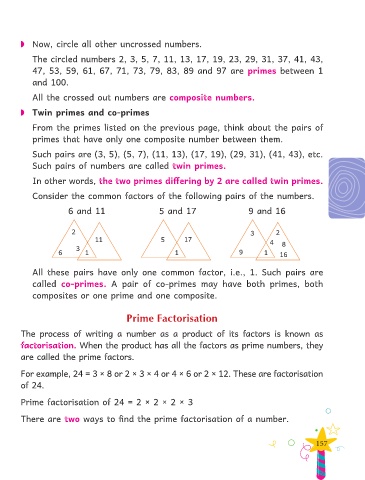
            Consider the common factors of the following pairs of the numbers.

                         6 and 11                       5 and 17                       9 and 16


                          2                                                             3       2
                                  11                     5       17                           4   8
                           3
                     6        1                              1                      9       1     16


            All  these  pairs  have  only  one  common  factor,  i.e.,  1.  Such  pairs  are

            called  co-primes.  A  pair  of  co-primes  may  have  both  primes,  both
            composites or one prime and one composite.


                                             Prime Factorisation


        The  process  of  writing  a  number  as  a  product  of  its  factors  is  known  as

        factorisation. When the product has all the factors as prime numbers, they
        are called the prime factors.


        For example, 24 = 3 × 8 or 2 × 3 × 4 or 4 × 6 or 2 × 12. These are factorisation
        of 24.


        Prime factorisation of 24 = 2 × 2 × 2 × 3


        There are two ways to find the prime factorisation of a number.


                                                                                                              157

