


Page 158 - New Medley 5 Semester 1
P. 158
2.  Even × even = even, even × odd = even, odd × even = even and odd × odd
                          = odd


                   Note: Any large number ending with the digits 1, 3, 5, 7 or 9 is an odd
                   number and ending with 0, 2, 4, 6 or 8 is an even number.


                 Z Z Prime and composite numbers

                   Consider the following products:


                   1 × 2 = 2, 1 × 3 = 3, 1 × 5 = 5, 1 × 7 = 7, 1 × 11 = 11, 1 × 13 = 13, etc.

                   All the numbers 2, 3, 5, 7, 11, 13,... have only two factors 1 and the

                   number  itself.  Hence,  these  are  prime  numbers.  Thus,  we  can  say,  a
                   number divisible by only two numbers 1 and the number itself is called

                   the prime number.

                   Now,  consider  the  factors  of  the  numbers  like  4,  6,  8,  9,  10,  etc.  4
                   has 1, 2 and 4 as its factors. 6 has 1, 2, 3 and 6 as its factors. Such

                   numbers are called composite numbers. Thus, we can say, a number

                   having more than two factors are called composite numbers.


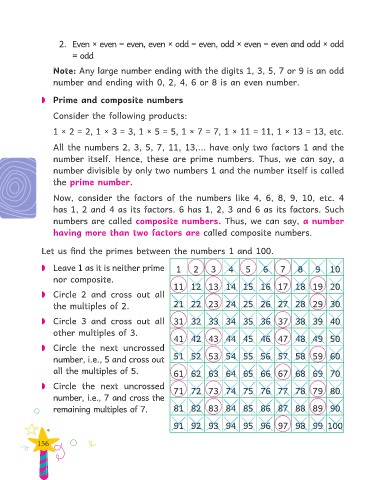
               Let us find the primes between the numbers 1 and 100.

                 Z Z Leave 1 as it is neither prime           1     2     3     4     5     6     7     8     9    10

                   nor composite.
                                                             11 12 13 14 15 16 17 18 19 20
                 Z Z Circle  2  and  cross  out  all
                   the multiples of 2.                       21 22 23 24 25 26 27 28 29 30


                 Z Z Circle  3  and  cross  out  all  31 32 33 34 35 36 37 38 39 40
                   other multiples of 3.
                                                             41 42 43 44 45 46 47 48 49 50
                 Z Z Circle  the  next  uncrossed
                                                             51 52 53 54 55 56 57 58 59 60
                   number, i.e., 5 and cross out
                   all the multiples of 5.                   61 62 63 64 65 66 67 68 69 70


                 Z Z Circle  the  next  uncrossed
                                                             71 72 73 74 75 76 77 78 79 80
                   number, i.e., 7 and cross the

                   remaining multiples of 7.                 81 82 83 84 85 86 87 88 89 90

                                                             91 92 93 94 95 96 97 98 99 100

              156

