


Page 155 - New Medley 5 Semester 1
P. 155
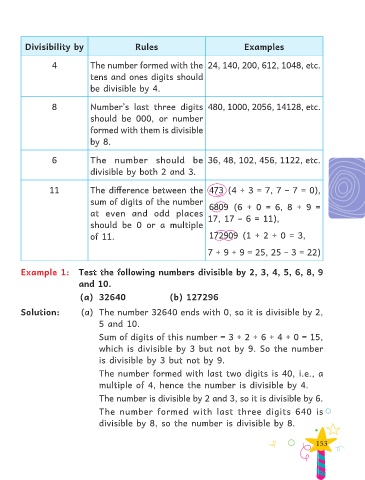
Divisibility by                       Rules                                Examples


                   4            The number formed with the  24, 140, 200, 612, 1048, etc.
                                tens and ones digits should
                                be divisible by 4.


                   8            Number’s  last  three  digits  480, 1000, 2056, 14128, etc.

                                should  be  000,  or  number
                                formed with them is divisible

                                by 8.


                   6            The  number should  be  36, 48, 102, 456, 1122, etc.
                                divisible by both 2 and 3.


                  11            The difference between the  473 (4 + 3 = 7, 7 – 7 = 0),

                                sum of digits of the number
                                                                         6809  (6  +  0  =  6,  8  +  9  =
                                at  even  and  odd  places
                                                                         17, 17 – 6 = 11),
                                should  be  0  or  a  multiple
                                of 11.                                   172909 (1 + 2 + 0 = 3,


                                                                         7 + 9 + 9 = 25, 25 – 3 = 22)


        Example 1:  Test the following numbers divisible by 2, 3, 4, 5, 6, 8, 9
                            and 10.

                             (a)  32640     (b) 127296


        Solution:            (a)  The number 32640 ends with 0, so it is divisible by 2,
                                   5 and 10.

                                   Sum of digits of this number = 3 + 2 + 6 + 4 + 0 = 15,
                                   which  is  divisible  by  3  but  not  by  9.  So  the  number

                                   is divisible by 3 but not by 9.

                                   The number formed with last two digits is 40, i.e., a
                                   multiple of 4, hence the number is divisible by 4.

                                   The number is divisible by 2 and 3, so it is divisible by 6.

                                   The  number  formed  with  last  three  digits  640  is

                                   divisible by 8, so the number is divisible by 8.

                                                                                                              153

