


Page 231 - New Medley 4 Semester 1
P. 231
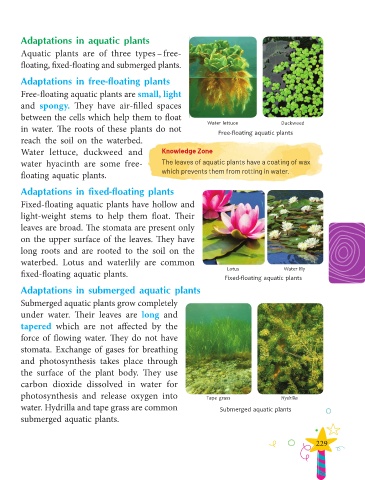
Adaptations in aquatic plants

        Aquatic plants are of three types – free-

        floating, fixed-floating and submerged plants.

        Adaptations in free-floating plants

        Free-floating aquatic plants are small, light
        and  spongy. They have air-filled spaces

        between the cells which help them to float
        in water. The roots of these plants do not                       Water lettuce            Duckweed
                                                                            Free-floating aquatic plants
        reach the soil on the waterbed.
        Water lettuce, duckweed and                      Knowledge Zone

        water  hyacinth  are  some  free-                The leaves of aquatic plants have a coating of wax
        floating aquatic plants.                         which prevents them from rotting in water.


        Adaptations in fixed-floating plants

        Fixed-floating aquatic plants have hollow and
        light-weight stems to help them float. Their

        leaves are broad. The stomata are present only
        on the upper surface of the leaves. They have

        long roots and are rooted to the soil on the
        waterbed. Lotus and waterlily are common
                                                                               Lotus
                                                                                                   Water lily
        fixed-floating aquatic plants.                                         Fixed-floating aquatic plants
        Adaptations in submerged aquatic plants

        Submerged aquatic plants grow completely
        under water. Their leaves are  long and

        tapered  which  are  not affected  by  the

        force of flowing water. They do not have
        stomata. Exchange of gases for breathing
        and photosynthesis takes place through

        the surface of the plant body. They use

        carbon dioxide dissolved in water for
        photosynthesis and release oxygen into                          Tape grass                Hydrilla
        water. Hydrilla and tape grass are common                            Submerged aquatic plants

        submerged aquatic plants.


                                                                                                              229

