


Page 242 - New Medley 5 Semester 2
P. 242
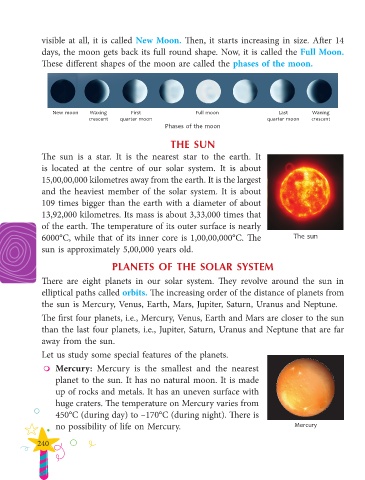
visible at all, it is called New Moon. en, it starts increasing in size. A er 14
days, the moon gets back its full round shape. Now, it is called the Full Moon.
ese di erent shapes of the moon are called the phases of the moon.
New moon Waxing First Full moon Last Waning
crescent quarter moon quarter moon crescent
Phases of the moon
THE SUN
e sun is a star. It is the nearest star to the earth. It
is located at the centre of our solar system. It is about
15,00,00,000 kilometres away from the earth. It is the largest
and the heaviest member of the solar system. It is about
109 times bigger than the earth with a diameter of about
13,92,000 kilometres. Its mass is about 3,33,000 times that
of the earth. e temperature of its outer surface is nearly
6000°C, while that of its inner core is 1,00,00,000°C. e The sun
sun is approximately 5,00,000 years old.
PLANETS OF THE SOLAR SYSTEM
ere are eight planets in our solar system. ey revolve around the sun in
elliptical paths called orbits. e increasing order of the distance of planets from
the sun is Mercury, Venus, Earth, Mars, Jupiter, Saturn, Uranus and Neptune.
e rst four planets, i.e., Mercury, Venus, Earth and Mars are closer to the sun
than the last four planets, i.e., Jupiter, Saturn, Uranus and Neptune that are far
away from the sun.
Let us study some special features of the planets.
Mercury: Mercury is the smallest and the nearest
planet to the sun. It has no natural moon. It is made
up of rocks and metals. It has an uneven surface with
huge craters. e temperature on Mercury varies from
450°C (during day) to –170°C (during night). ere is
no possibility of life on Mercury. Mercury
240

