


Page 243 - New Medley 5 Semester 2
P. 243
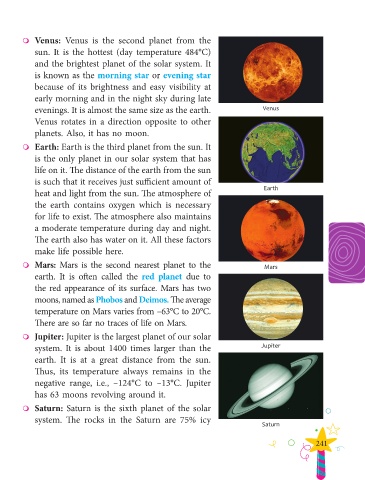
Venus: Venus is the second planet from the
sun. It is the hottest (day temperature 484°C)
and the brightest planet of the solar system. It
is known as the morning star or evening star
because of its brightness and easy visibility at
early morning and in the night sky during late
evenings. It is almost the same size as the earth. Venus
Venus rotates in a direction opposite to other
planets. Also, it has no moon.
Earth: Earth is the third planet from the sun. It
is the only planet in our solar system that has
life on it. e distance of the earth from the sun
is such that it receives just su cient amount of
heat and light from the sun. e atmosphere of Earth
the earth contains oxygen which is necessary
for life to exist. e atmosphere also maintains
a moderate temperature during day and night.
e earth also has water on it. All these factors
make life possible here.
Mars: Mars is the second nearest planet to the Mars
earth. It is o en called the red planet due to
the red appearance of its surface. Mars has two
moons, named as Phobos and Deimos. e average
temperature on Mars varies from –63°C to 20°C.
ere are so far no traces of life on Mars.
Jupiter: Jupiter is the largest planet of our solar
system. It is about 1400 times larger than the Jupiter
earth. It is at a great distance from the sun.
us, its temperature always remains in the
negative range, i.e., –124°C to –13°C. Jupiter
has 63 moons revolving around it.
Saturn: Saturn is the sixth planet of the solar
system. e rocks in the Saturn are 75% icy
Saturn
241

