


Page 244 - New Medley 5 Semester 2
P. 244
hydrogen and 25% icy helium with traces of
water. It has 34 moons and nearly 8 prominent
rings around it.
Uranus: Uranus is an almost featureless planet
in visible light. It has 27 moons and also a few
rings around it. It is a gaseous planet.
Uranus
Neptune: Neptune is the farthest planet of
our solar system. It has a blue colour and
is a typical gas planet. Its main feature is its
Great Dark Spot in its southern hemisphere.
It mainly consists of ice rocks of hydrogen
and helium. It is the fourth largest planet of our
solar system and has 13 moons. Neptune
1 • Remembering
Name the following.
1. e planet known as evening star
2. e natural satellite of the Earth
3. e main feature of the planet Neptune
4. e largest planet of the solar system
ECLIPSES
When the light of the sun is blocked by the moon or the earth, a shadow is
formed on the other one. is is called an eclipse. Eclipses are of two types –
Solar eclipse and lunar eclipse.
Solar Eclipse
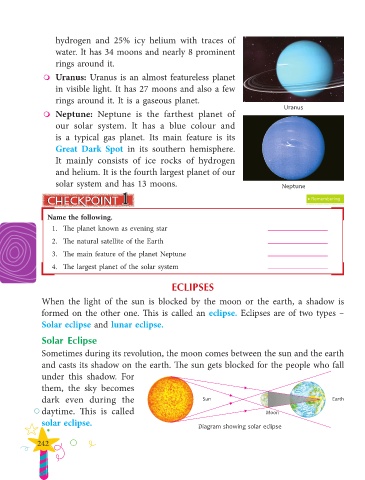
Sometimes during its revolution, the moon comes between the sun and the earth
and casts its shadow on the earth. e sun gets blocked for the people who fall
under this shadow. For
them, the sky becomes
dark even during the Sun Earth
daytime. is is called Moon
solar eclipse. Diagram showing solar eclipse
242

