


Page 247 - New Medley 5 Semester 2
P. 247
e Soviet Union USSR launched the  rst arti cial satellite,
        Sputnik 1, in 1957. Since then, the United States and about
        40 other countries have developed, launched and operated


        arti cial satellites. India launched its  rst satellite in 1975.
        It was named Aryabhata. Other Indian satellites include
        Bhaskara I and II, Rohini, APPLE, INSAT, Chandrayaan,                                 Aryabhata
        GSAT, Mangalyaan, XPOSAT, etc.


        Types of Artificial Satellites                             Knowledge Zone

        Arti cial satellites are classi ed according              The satellites Aryabhata and Bhaskara were

        to their mission.  eir main function is to                named so to honour our great astronomers

                                                                  and mathematicians Aryabhata and
        collect information for various purposes.                 Bhaskaracharya respectively.
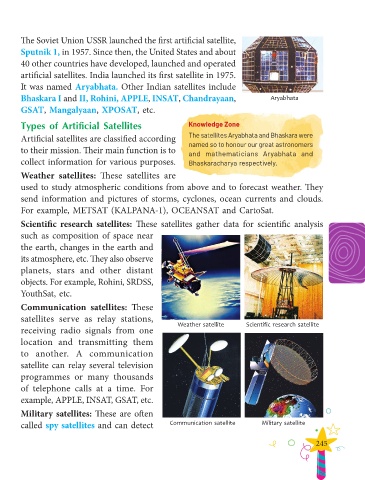
        Weather satellites:   ese  satellites  are

        used to study atmospheric conditions from above and to forecast weather.  ey

        send information and pictures of storms, cyclones, ocean currents and clouds.
        For example, METSAT (KALPANA-1), OCEANSAT and CartoSat.


        Scienti c  research  satellites:  ese satellites gather data for scienti c analysis


        such  as  composition  of  space  near
        the earth, changes in the earth and
        its atmosphere, etc.  ey also observe

        planets, stars and other distant

        objects. For example, Rohini, SRDSS,
        YouthSat, etc.

        Communication satellites:    ese
        satellites serve as relay stations,

        receiving radio signals from one                      Weather satellite       Scientific research satellite
        location and transmitting them

        to another. A communication
        satellite can relay several television

        programmes or  many  thousands
        of telephone calls at a time. For

        example, APPLE, INSAT, GSAT, etc.


        Military satellites:  ese are o en
        called spy satellites and can detect                Communication satellite        Military satellite

                                                                                                              245
                                                                                                                           v  v

