


Page 325 - New Medley 5 Semester 1
P. 325
respectively. If one draws parallels at an interval of 1° from North Pole

        to South Pole, the total number of parallels including the equator will
        be 181. There are many parallels, which are considered important on the

        globe. Seven of them are as under:


          1.  North Pole                    – 90° N             2.  Arctic Circle            – 66.5° N

          3.  Tropic of Cancer              – 23.5° N           4.  Equator                  – 0°

          5.  Tropic of Capricorn – 23.5° S                     6.  Antarctic Circle  – 66.5° S

          7.  South Pole                    – 90° S


                                                     Meridians

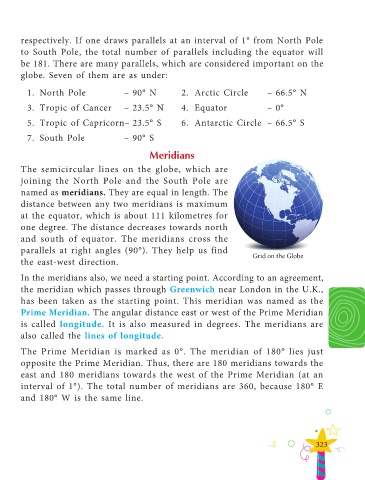
        The semicircular lines on the globe, which are

        joining the North Pole and the South Pole are
        named as meridians. They are equal in length. The

        distance between any two meridians is maximum
        at the equator, which is about 111 kilometres for

        one degree. The distance decreases towards north
        and south of equator. The meridians cross the

        parallels at right angles (90°). They help us find                              Grid on the Globe
        the east-west direction.

        In the meridians also, we need a starting point. According to an agreement,

        the meridian which passes through Greenwich near London in the U.K.,

        has been taken as the starting point. This meridian was named as the
        Prime Meridian. The angular distance east or west of the Prime Meridian
        is called  longitude. It is also measured in degrees. The meridians are

        also called the  lines of longitude.

        The Prime Meridian is marked as 0°. The meridian of 180° lies just

        opposite the Prime Meridian. Thus, there are 180 meridians towards the
        east and 180 meridians towards the west of the Prime Meridian (at an

        interval of 1°). The total number of meridians are 360, because 180° E
        and 180° W is the same line.


                                                                                                              323

