


Page 324 - New Medley 5 Semester 1
P. 324
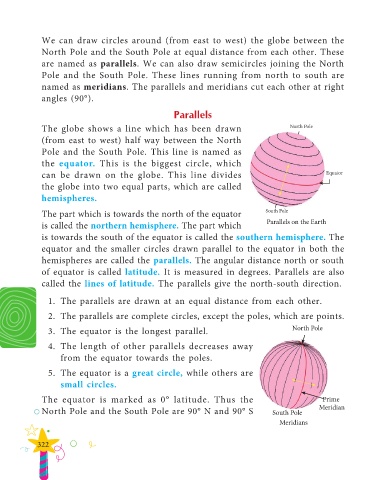
We  can draw circles around (from  east  to west) the globe between the

               North Pole and the South Pole at equal distance from each other. These
               are named as parallels. We can also draw semicircles joining the North

               Pole and the South Pole. These lines running from north to south are
               named as meridians. The parallels and meridians cut each other at right

               angles (90°).

                                                             Parallels

               The  globe  shows  a  line  which  has  been  drawn                                   North Pole

               (from east to west) half way between the North
               Pole and the South Pole. This line is named as

               the  equator. This is the biggest circle, which
               can be drawn on the globe. This line divides                                                       Equator

               the globe into two equal parts, which are called
               hemispheres.


               The part which is towards the north of the equator                            South Pole
               is called the northern hemisphere. The part which                             Parallels on the Earth

               is towards the south of the equator is called the southern hemisphere. The
               equator and the smaller circles drawn parallel to the equator in both the

               hemispheres are called the parallels. The angular distance north or south
               of equator is called latitude. It is measured in degrees. Parallels are also

               called the  lines of latitude. The parallels give the north-south direction.


                 1.  The parallels are drawn at an equal distance from each other.

                 2.  The parallels are complete circles, except the poles, which are points.

                 3.  The equator is the longest parallel.                                             North Pole

                 4.  The length of other parallels decreases away

                      from the equator towards the poles.

                 5.  The equator is a great circle, while others are

                      small circles.

               The equator is marked as 0° latitude. Thus the                                                   Prime
               North Pole and the South Pole are 90° N and 90° S                               South Pole       Meridian

                                                                                                 Meridians


              322

