


Page 330 - New Medley 5 Semester 1
P. 330
surface of the Earth. They cover more than 20 per cent of the total area

               of landmasses.

               At first sight, all mountains look alike,

               but they are formed in different ways. The
               height  and  shape  of  the  mountains  vary

               from region to region. The peaks can be
               conical or rounded. All these variations

               depend upon the age of the mountains.
               Accordingly, the mountains can be young

               (Himalayas) or old (Aravallis).
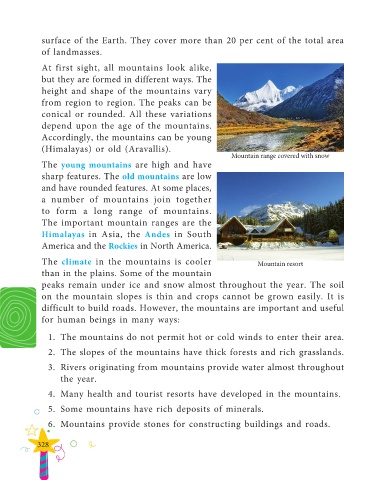
                                                                                 Mountain range covered with snow
               The  young mountains are high and have

               sharp features. The old mountains are low
               and have rounded features. At some places,

               a number of mountains join together
               to form a long range of mountains.

               The important mountain ranges are the
               Himalayas  in Asia, the  Andes in South

               America and the Rockies in North America.

               The  climate in the mountains is cooler                                    Mountain resort

               than in the plains. Some of the mountain
               peaks remain under ice and snow almost throughout the year. The soil
               on the mountain slopes is thin and crops cannot be grown easily. It is

               difficult to build roads. However, the mountains are important and useful

               for human beings in many ways:

                 1.  The mountains do not permit hot or cold winds to enter their area.


                 2.  The slopes of the mountains have thick forests and rich grasslands.

                 3.  Rivers originating from mountains provide water almost throughout
                      the year.


                 4.  Many health and tourist resorts have developed in the mountains.

                 5.  Some mountains have rich deposits of minerals.

                 6.  Mountains provide stones for constructing buildings and roads.


              328

