


Page 298 - New Medley 5 Semester 1
P. 298
Some insects like housefly carry disease-causing germs on their feet. They
sit on filthy garbage in order to get food. The germs stick to their feet from
garbage. When the same housefly sits on the food or clothing, the germs
are likely to reach there. Mosquitoes and houseflies are the most common
vectors.
Prevention of Communicable Diseases
The spread of communicable diseases can be minimised if a few simple safety
measures are followed:
The surroundings should be kept clean.
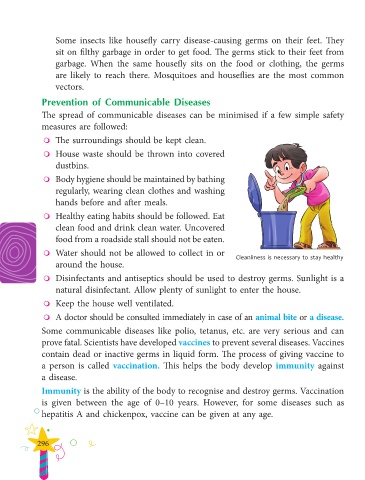
House waste should be thrown into covered
dustbins.
Body hygiene should be maintained by bathing
regularly, wearing clean clothes and washing
hands before and after meals.
Healthy eating habits should be followed. Eat
clean food and drink clean water. Uncovered
food from a roadside stall should not be eaten.
Water should not be allowed to collect in or Cleanliness is necessary to stay healthy
around the house.
Disinfectants and antiseptics should be used to destroy germs. Sunlight is a
natural disinfectant. Allow plenty of sunlight to enter the house.
Keep the house well ventilated.
A doctor should be consulted immediately in case of an animal bite or a disease.
Some communicable diseases like polio, tetanus, etc. are very serious and can
prove fatal. Scientists have developed vaccines to prevent several diseases. Vaccines
contain dead or inactive germs in liquid form. The process of giving vaccine to
a person is called vaccination. This helps the body develop immunity against
a disease.
Immunity is the ability of the body to recognise and destroy germs. Vaccination
is given between the age of 0–10 years. However, for some diseases such as
hepatitis A and chickenpox, vaccine can be given at any age.
296

