


Page 275 - New Medley 5 Semester 1
P. 275
Voluntary muscles: These muscles are under our control. They are attached to the

        bones. Hence, they are also called skeletal muscles. The arms, legs, hands, etc. have
        voluntary muscles. That is why we can control our actions while running, jumping,

        walking, etc.

          Involuntary muscles: These muscles do not work at our will. They work without
        our thinking about them. So, we cannot control them. Our stomach and heart

        have involuntary muscles. The heart beats and the stomach digests food, even
        while we are asleep.

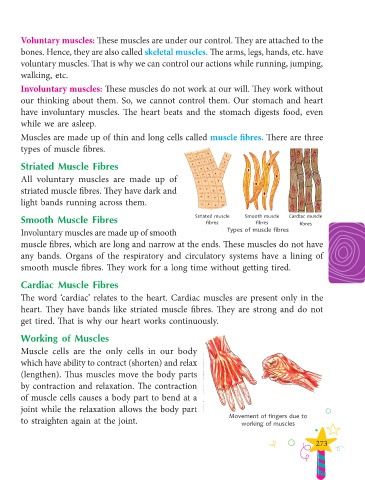
        Muscles are made up of thin and long cells called muscle fibres. There are three

        types of muscle fibres.

        Striated Muscle Fibres

        All voluntary muscles are made up of

        striated muscle fibres. They have dark and
        light bands running across them.


        Smooth Muscle Fibres                                        Striated muscle   Smooth muscle   Cardiac muscle
                                                                                         fibres
                                                                        fibres
                                                                                                        fibres
        Involuntary muscles are made up of smooth                              Types of muscle fibres
        muscle fibres, which are long and narrow at the ends. These muscles do not have

        any  bands. Organs  of the  respiratory  and  circulatory  systems  have  a  lining  of
        smooth muscle fibres. They work for a long time without getting tired.


        Cardiac Muscle Fibres

        The word ‘cardiac’ relates to the heart. Cardiac muscles are present only in the
        heart.  They  have  bands  like  striated  muscle  fibres.  They  are  strong  and  do  not

        get tired. That is why our heart works continuously.


        Working of Muscles
        Muscle cells are the only cells in our body

        which have ability to contract (shorten) and relax
        (lengthen). Thus muscles move the body parts

        by contraction and relaxation. The contraction
        of muscle cells causes a body part to bend at a

        joint while the relaxation allows the body part
        to straighten again at the joint.                                       Movement of fingers due to
                                                                                    working of muscles


                                                                                                              273

