


Page 273 - New Medley 5 Semester 1
P. 273
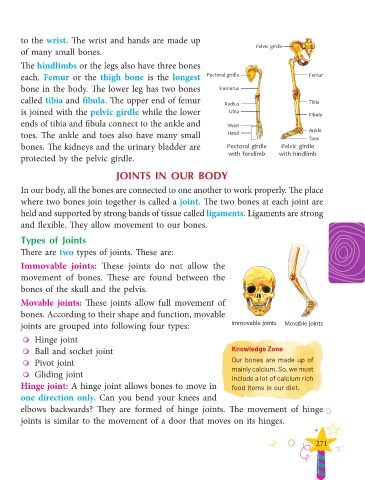
to the wrist. The wrist and hands are made up
of many small bones. Pelvic girdle
The hindlimbs or the legs also have three bones
each. Femur or the thigh bone is the longest Pectoral girdle Femur
bone in the body. The lower leg has two bones Humerus
called tibia and fibula. The upper end of femur Radius Tibia
is joined with the pelvic girdle while the lower Ulna Fibula
ends of tibia and fibula connect to the ankle and Wrist
toes. The ankle and toes also have many small Hand Ankle
Toes
bones. The kidneys and the urinary bladder are Pectoral girdle Pelvic girdle
protected by the pelvic girdle. with forelimb with hindlimb
JOINTS IN OUR BODY
In our body, all the bones are connected to one another to work properly. The place
where two bones join together is called a joint. The two bones at each joint are
held and supported by strong bands of tissue called ligaments. Ligaments are strong
and flexible. They allow movement to our bones.
Types of Joints
There are two types of joints. These are:
Immovable joints: These joints do not allow the
movement of bones. These are found between the
bones of the skull and the pelvis.
Movable joints: These joints allow full movement of
bones. According to their shape and function, movable
joints are grouped into following four types: Immovable joints Movable joints
Hinge joint
Ball and socket joint Knowledge Zone
Pivot joint Our bones are made up of
Gliding joint mainly calcium. So, we must
include a lot of calcium rich
Hinge joint: A hinge joint allows bones to move in food items in our diet.
one direction only. Can you bend your knees and
elbows backwards? They are formed of hinge joints. The movement of hinge
joints is similar to the movement of a door that moves on its hinges.
271

