


Page 272 - New Medley 5 Semester 1
P. 272
Parts of the Skeleton

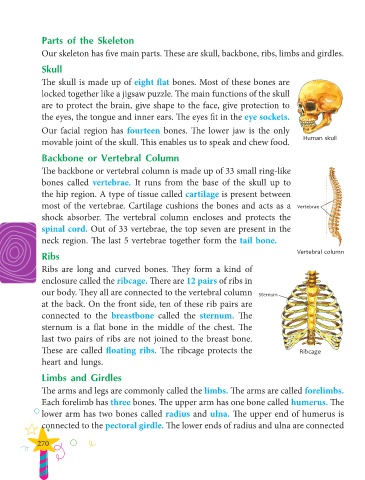
               Our skeleton has five main parts. These are skull, backbone, ribs, limbs and girdles.


               Skull
               The skull is made up of eight flat bones. Most of these bones are

               locked together like a jigsaw puzzle. The main functions of the skull
               are to protect the brain, give shape to the face, give protection to

               the eyes, the tongue and inner ears. The eyes fit in the eye sockets.

               Our facial region has  fourteen bones. The lower jaw is the only
               movable joint of the skull. This enables us to speak and chew food.                        Human skull


               Backbone or Vertebral Column

               The backbone or vertebral column is made up of 33 small ring-like
               bones called  vertebrae. It runs from the base of the skull up to
               the hip region. A type of tissue called cartilage is present between


               most of the vertebrae. Cartilage cushions the bones and acts as a  Vertebrae
               shock  absorber.  The  vertebral  column  encloses  and  protects  the
               spinal cord. Out of 33 vertebrae, the top seven are present in the
               neck region. The last 5 vertebrae together form the tail bone.


               Ribs                                                                                     Vertebral column

               Ribs are long and curved bones. They form a kind of
               enclosure called the ribcage. There are 12 pairs of ribs in


               our body. They all are connected to the vertebral column  Sternum
               at the back. On the front side, ten of these rib pairs are

               connected to the  breastbone called the  sternum. The
               sternum is a flat bone in the middle of the chest. The

               last two pairs of ribs are not joined to the breast bone.
               These are called floating ribs. The ribcage protects the                                 Ribcage

               heart and lungs.

               Limbs and Girdles

               The arms and legs are commonly called the limbs. The arms are called forelimbs.
               Each forelimb has three bones. The upper arm has one bone called humerus. The

               lower arm has two bones called radius and ulna. The upper end of humerus is
               connected to the pectoral girdle. The lower ends of radius and ulna are connected


              270

