


Page 267 - New Medley 5 Semester 1
P. 267
MIGRATION
During unfavourable conditions, the habitat fails to provide sufficient food, water
and suitable conditions of temperature or breeding. So to find suitable conditions,
some animals move out to places far away from their original habitats. They return
to their habitat when the conditions become favourable again. This movement
is known as migration.
Migration takes place by flying, swimming, walking, hopping, burrowing or slithering.
True migrants are some birds which make a two-way
journey every year from one place to another and back
again.
Some birds travel in large flocks so that they can take
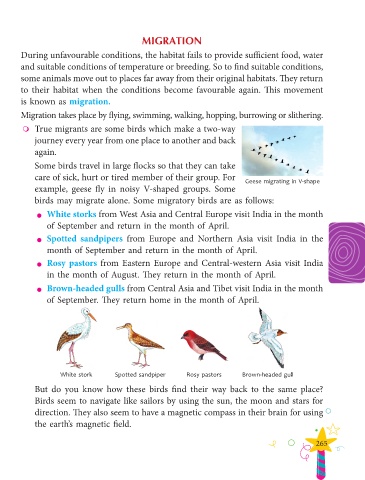
care of sick, hurt or tired member of their group. For Geese migrating in V-shape
example, geese fly in noisy V-shaped groups. Some
birds may migrate alone. Some migratory birds are as follows:
l White storks from West Asia and Central Europe visit India in the month
of September and return in the month of April.
l Spotted sandpipers from Europe and Northern Asia visit India in the
month of September and return in the month of April.
l Rosy pastors from Eastern Europe and Central-western Asia visit India
in the month of August. They return in the month of April.
l Brown-headed gulls from Central Asia and Tibet visit India in the month
of September. They return home in the month of April.
White stork Spotted sandpiper Rosy pastors Brown-headed gull
But do you know how these birds find their way back to the same place?
Birds seem to navigate like sailors by using the sun, the moon and stars for
direction. They also seem to have a magnetic compass in their brain for using
the earth’s magnetic field.
265

