


Page 221 - New Medley 5 Semester 1
P. 221
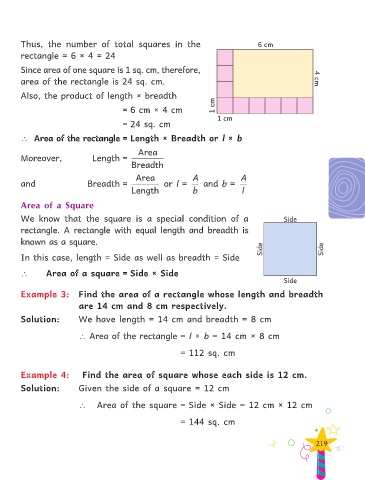
Thus,  the  number  of  total  squares  in  the                                   6 cm
        rectangle = 6 × 4 = 24

        Since area of one square is 1 sq. cm, therefore,

        area of the rectangle is 24 sq. cm.                                                                   4 cm

        Also, the product of length × breadth

                                           = 6 cm × 4 cm                   1 cm
                                                                            1 cm
                                           = 24 sq. cm

        \  Area of the rectangle = Length × Breadth or l × b

                                                 Area
        Moreover,                Length =
                                              Breadth
                                                Area               A                A
        and                    Breadth =                 or l =        and b =
                                              Length               b                l

        Area of a Square

        We  know  that  the  square  is  a  special  condition  of  a                              Side

        rectangle. A rectangle with equal length and breadth is

        known as a square.
                                                                                            Side                 Side
        In this case, length = Side as well as breadth = Side

        \        Area of a square = Side × Side
                                                                                                   Side

        Example 3:  Find the area of a rectangle whose length and breadth
                            are 14 cm and 8 cm respectively.

        Solution:           We have length = 14 cm and breadth = 8 cm


                            \ Area of the rectangle = l × b = 14 cm × 8 cm

                                                               = 112 sq. cm


        Example 4:   Find the area of square whose each side is 12 cm.

        Solution:           Given the side of a square = 12 cm


                            \   Area of the square = Side × Side = 12 cm × 12 cm

                                                               = 144 sq. cm


                                                                                                              219

