


Page 197 - New Medley 5 Semester 1
P. 197
Need of Decimals


        In our day-to-day life, we have to deal many situations like expressing the

        amount of money, weights, heights, quantities of liquid, etc., where we use
        decimals.  Let  us  discuss  a  situation  here  to  recall  what  we  learnt  in  Class
        4.  Can  you  guess  how  thick  a  postcard  or  your  pencil  tip  is?  It  is  about  1
        mm. Where do you see 1 mm measure? Observe your ruler markings from 1
        to 15. The distance between two consecutive numbers is 1 cm. Further, each

        one is divided into 10 equal parts. This one division shows 1 mm. That means,
                                                                        1
        1 mm is tenth part of 1 cm. Hence, 1 mm =                           cm. It also can be written
                                                                       10
        as .1 cm or 0.1 cm. The point (.) here used is known as the decimal. It is

        used to separate the whole number and the decimal part.

        Do you know the length of a 10-rupee note? It is 13 cm 5 mm. It is written
        in centimetre as 13.5 cm.

        In the same way, if your height is 1 m 35 cm, you can write it as 1.35 m
                                   35
        because 35 cm =                  m or 0.35 m.
                                  100
        How to Read and Write a Decimal

        Have you thought what places are to the right of the ones place in a place-

        value chart?
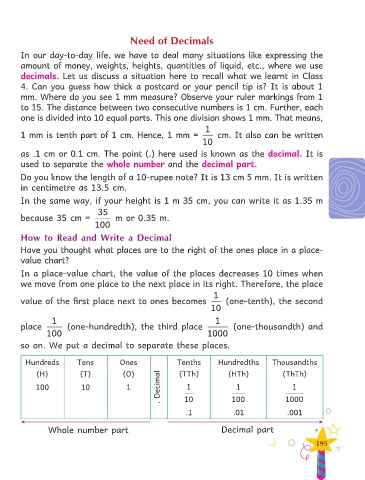
        In a place-value chart, the value of the places decreases 10 times when
        we move from one place to the next place in its right. Therefore, the place

                                                                           1
        value of the first place next to ones becomes                          (one-tenth), the second
                                                                          10

                   1                                                       1
        place            (one-hundredth),  the  third  place                      (one-thousandth)  and
                 100                                                     1000

        so on. We put a decimal to separate these places.


          Hundreds          Tens          Ones                Tenths        Hundredths         Thousandths
                                                        . Decimal  1               1                  1
              (H)            (T)            (O)                (TTh)            (HTh)              (ThTh)
             100             10              1                   10              100                1000


                                                                 .1              .01                .001


                  Whole number part                                          Decimal part
                                                                                                              195

