


Page 218 - New Medley 4 Semester 2 PDF (Merged)
P. 218
Water kept in the plate evaporates faster. The activity shows that evaporation is

               faster when the surface area is larger.
                                                                                                        • Hands-on Learning
                   Activity


                 To check the effect of speed of wind on evaporation
                 Take two identical handkerchiefs and dip them in water. Squeeze the water from them. Now,
                 hang one of them in a room under the fan and the other one in a corner where the air of the fan
                 cannot reach. Observe both the handkerchiefs after 15 minutes. Which handkerchief dries first?
                 Can you say why?


               The handkerchief hung under the fan dries first. This activity shows that the rate

               of evaporation is faster for a higher speed of wind.
               Have you ever thought why clothes dry faster on a hot sunny day than on a

               rainy day? During rainy days, the air has more moisture (water vapour) in it.

               The amount of water vapour present in air is called humidity. When humidity
               is high, the rate of evaporation is low. During summers, humidity is low and
               the rate of evaporation is faster. Therefore, clothes dry faster on a hot sunny day.


               Condensation
               The process of changing of water vapour into liquid water on cooling is called

               condensation. In nature, clouds are formed by the condensation of water vapour
               in the atmosphere.

               Precipitation

               All liquid and solid forms of water falling from the atmosphere on the Earth’s

               surface is called precipitation. Rain, snow, hail, dew, fog and frost are different
               forms of precipitation.

               Rain

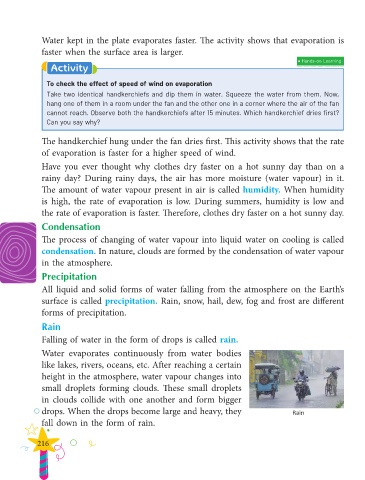
               Falling of water in the form of drops is called rain.

               Water evaporates continuously from water bodies
               like lakes, rivers, oceans, etc. After reaching a certain

               height in the atmosphere, water vapour changes into
               small droplets forming clouds. These small droplets

               in clouds collide with one another and form bigger
               drops. When the drops become large and heavy, they                                     Rain

               fall down in the form of rain.


              216

