


Page 237 - New Medley 4 Semester 1
P. 237
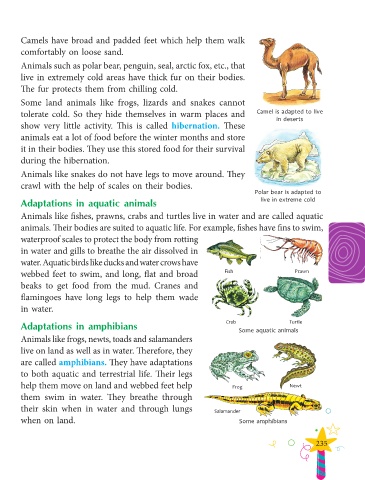
Camels have broad and padded feet which help them walk

        comfortably on loose sand.

        Animals such as polar bear, penguin, seal, arctic fox, etc., that
        live in extremely cold areas have thick fur on their bodies.

        The fur protects them from chilling cold.

        Some land animals like frogs, lizards and snakes cannot
        tolerate cold. So they hide themselves in warm places and                         Camel is adapted to live
                                                                                                in deserts
        show very little activity. This is called  hibernation. These
        animals eat a lot of food before the winter months and store

        it in their bodies. They use this stored food for their survival
        during the hibernation.

        Animals like snakes do not have legs to move around. They

        crawl with the help of scales on their bodies.
                                                                                         Polar bear is adapted to
        Adaptations in aquatic animals                                                     live in extreme cold

        Animals like fishes, prawns, crabs and turtles live in water and are called aquatic

        animals. Their bodies are suited to aquatic life. For example, fishes have fins to swim,
        waterproof scales to protect the body from rotting

        in water and gills to breathe the air dissolved in
        water. Aquatic birds like ducks and water crows have

        webbed feet to swim, and long, flat and broad                          Fish                    Prawn
        beaks to get food from the mud. Cranes and

        flamingoes have long legs to help them wade
        in water.


                                                                                                     Turtle
        Adaptations in amphibians                                              Crab  Some aquatic animals
        Animals like frogs, newts, toads and salamanders
        live on land as well as in water. Therefore, they

        are called amphibians. They have adaptations
        to both aquatic and terrestrial life. Their legs

        help them move on land and webbed feet help                              Frog                Newt
        them  swim  in water.  They  breathe  through

        their skin when in water and through lungs                         Salamander
        when on land.                                                               Some amphibians


                                                                                                              235

