


Page 273 - New Medley 5 Semester 2
P. 273
The low cost of transport helps in the transportation of foodgrains,

        agricultural raw materials and mineral ores. Special types of ships are
        constructed to carry dairy products, vegetables and fruits. Many rivers

        are also used by big steamers to transport men and materials.

        The construction of the Suez Canal and the

        Panama Canal  has reduced the distance
        among the Asian, European and American

        countries. Today, the busiest sea route in
        the world is between Western Europe and

        Eastern North America. It is the  North
        Atlantic Sea Route.


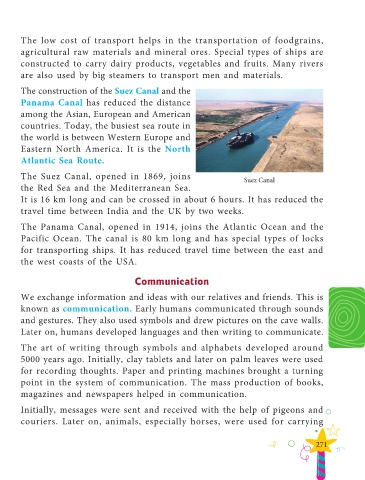
        The Suez Canal, opened in 1869, joins                                        Suez Canal
        the Red Sea and the Mediterranean Sea.

        It is 16 km long and can be crossed in about 6 hours. It has reduced the
        travel time between India and the UK by two weeks.


        The Panama Canal, opened in 1914, joins the Atlantic Ocean and the
        Pacific Ocean. The canal is 80 km long and has special types of locks
        for transporting ships. It has reduced travel time between the east and

        the west coasts of the USA.


                                                Communication

        We exchange information and ideas with our relatives and friends. This is
        known as communication. Early humans communicated through sounds

        and gestures. They also used symbols and drew pictures on the cave walls.
        Later on, humans developed languages and then writing to communicate.


        The art of writing through symbols and alphabets developed around
        5000 years ago. Initially, clay tablets and later on palm leaves were used

        for recording thoughts. Paper and printing machines brought a turning
        point in the system of communication. The mass production of books,

        magazines and newspapers helped in communication.

        Initially, messages were sent and received with the help of pigeons and

        couriers. Later on, animals, especially horses, were used for carrying


                                                                                                              271

