


Page 161 - New Medley 5 Semester 2
P. 161
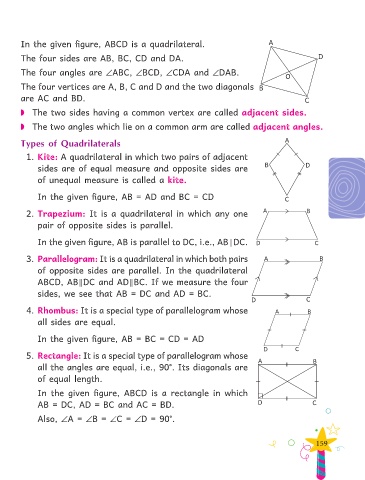
In the given figure, ABCD is a quadrilateral. A
The four sides are AB, BC, CD and DA. D
The four angles are ABC, BCD, CDA and DAB.
O
The four vertices are A, B, C and D and the two diagonals B
are AC and BD. C
The two sides having a common vertex are called adjacent sides.
The two angles which lie on a common arm are called adjacent angles.
Types of Quadrilaterals A
1. Kite: A quadrilateral in which two pairs of adjacent
B D
sides are of equal measure and opposite sides are
of unequal measure is called a kite.
In the given figure, AB = AD and BC = CD C
2. Trapezium: It is a quadrilateral in which any one A B
pair of opposite sides is parallel.
In the given figure, AB is parallel to DC, i.e., ABDC. D C
3. Parallelogram: It is a quadrilateral in which both pairs A B
of opposite sides are parallel. In the quadrilateral
ABCD, ABDC and ADBC. If we measure the four
sides, we see that AB = DC and AD = BC.
D C
4. Rhombus: It is a special type of parallelogram whose A B
all sides are equal.
In the given figure, AB = BC = CD = AD
D C
5. Rectangle: It is a special type of parallelogram whose
A B
all the angles are equal, i.e., 90°. Its diagonals are
of equal length.
In the given figure, ABCD is a rectangle in which
AB = DC, AD = BC and AC = BD. D C
Also, A = B = C = D = 90°.
159

