


Page 160 - New Medley 5 Semester 2
P. 160
EXERCISE 7.2


                A.  Can a triangle have following measures of angles?

                     1.  33°, 67°, 80°                2.  90°, 90°, 0°                 3.  100°, 60°, 10°


                     4.  75°, 85°, 20°                5.  105°, 110°, 25°              6.  40°, 50°, 60°


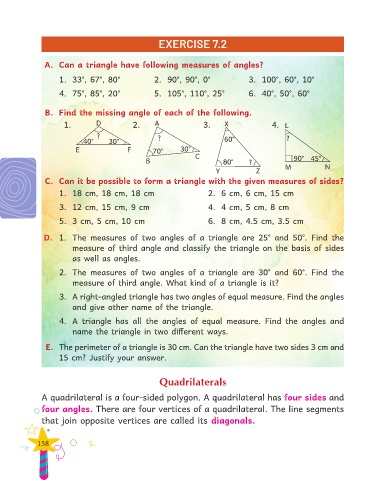
                B.  Find the missing angle of each of the following.
                       1.         D            2.     A                 3.    X                4. L

                                  ?                    ?                                            ?
                              40°      30°                                    60°
                           E                 F        70°      30°
                                                                    C                                 90°   45°
                                                   B                          80°      ?
                                                                                                   M             N
                                                                           Y             Z
                C.  Can it be possible to form a triangle with the given measures of sides?

                     1.  18 cm, 18 cm, 18 cm                             2.  6 cm, 6 cm, 15 cm

                     3.  12 cm, 15 cm, 9 cm                              4.  4 cm, 5 cm, 8 cm

                     5.  3 cm, 5 cm, 10 cm                               6.  8 cm, 4.5 cm, 3.5 cm


                D. 1. The  measures  of  two  angles  of  a  triangle  are  25°  and  50°.  Find  the
                          measure  of third  angle  and  classify  the  triangle  on  the  basis  of  sides
                          as well as angles.

                     2.  The  measures  of  two  angles  of  a  triangle  are  30°  and  60°.  Find  the
                          measure of third angle. What kind of a triangle is it?

                     3.  A right-angled triangle has two angles of equal measure. Find the angles

                          and give other name of the triangle.

                     4.  A  triangle  has  all  the  angles  of  equal  measure.  Find  the  angles  and

                          name the triangle in two different ways.
                 E.  The perimeter of a triangle is 30 cm. Can the triangle have two sides 3 cm and
                     15 cm? Justify your answer.


                                                        Quadrilaterals


               A quadrilateral is a four-sided polygon. A quadrilateral has four sides and

               four angles. There are four vertices of a quadrilateral. The line segments
               that join opposite vertices are called its diagonals.


              158

