


Page 250 - New Medley 4 Semester 2 PDF (Merged)
P. 250
Galaxy

               A galaxy is a huge group of stars that contains billions of stars. Stars that are

               visible to us belong to the  Milky  Way  galaxy. There are billions of galaxies
               in  the  universe.  This  makes  the  total  number  of  stars  in  the  night  sky  almost

               uncountable. Does this give you an idea of the size of universe?

                                                   THE SOLAR SYSTEM

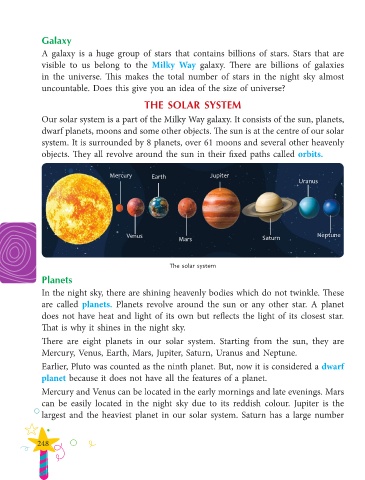
               Our solar system is a part of the Milky Way galaxy. It consists of the sun, planets,

               dwarf planets, moons and some other objects. The sun is at the centre of our solar
               system. It is surrounded by 8 planets, over 61 moons and several other heavenly

               objects. They all revolve around the sun in their fixed paths called orbits.


                                       Mercury       Earth                Jupiter
                                                                                                        Uranus


                                             Venus                                                             Neptune
                                                               Mars                         Saturn


                                                            The solar system

               Planets

               In the night sky, there are shining heavenly bodies which do not twinkle. These
               are called  planets. Planets revolve around the sun or any other star. A planet

               does not have heat and light of its own but reflects the light of its closest star.
               That is why it shines in the night sky.

               There are eight planets in our solar system. Starting from the sun, they are

               Mercury, Venus, Earth, Mars, Jupiter, Saturn, Uranus and Neptune.

               Earlier, Pluto was counted as the ninth planet. But, now it is considered a dwarf
               planet because it does not have all the features of a planet.

               Mercury and Venus can be located in the early mornings and late evenings. Mars

               can be easily located in the night sky due to its reddish colour. Jupiter is the
               largest and the heaviest planet in our solar system. Saturn has a large number


              248

