


Page 252 - New Medley 4 Semester 2 PDF (Merged)
P. 252
Sometimes, the molten rocks in the mantle find a weak spot in the Earth’s crust.

               They break through this weak point and the hot boiling liquid called lava, along
               with some gases, rushes out of the Earth’s crust. This is called a volcano.


               What causes day and night
                                                                                                         Axis
               The Earth spins just like a top. It spins about                                           North pole
               an imaginary line passing through its north and
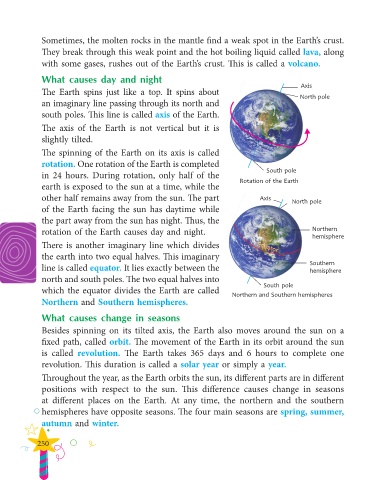
               south poles. This line is called axis of the Earth.

               The axis of the Earth is not vertical but it is

               slightly tilted.

               The spinning of the Earth on its axis is called
               rotation. One rotation of the Earth is completed
               in 24 hours. During rotation, only half of the                                South pole

               earth is exposed to the sun at a time, while the                     Rotation of the Earth
               other half remains away from the sun. The part                              Axis       North pole

               of the Earth facing the sun has daytime while
               the part away from the sun has night. Thus, the

               rotation of the Earth causes day and night.                                                   Northern
                                                                                                             hemisphere
               There is another imaginary line which divides                              Equator
                                                                                          Equator
               the earth into two equal halves. This imaginary
               line is called equator. It lies exactly between the                                          Southern
                                                                                                            hemisphere
               north and south poles. The two equal halves into
                                                                                            South pole
               which the equator divides the Earth are called                    Northern and Southern hemispheres
               Northern and Southern hemispheres.

               What causes change in seasons

               Besides spinning on its tilted axis, the Earth also moves around the sun on a
               fixed path, called orbit. The movement of the Earth in its orbit around the sun

               is called  revolution. The Earth takes 365 days and 6 hours to complete one
               revolution. This duration is called a solar year or simply a year.

               Throughout the year, as the Earth orbits the sun, its different parts are in different
               positions with respect to the sun. This difference causes change in seasons

               at different places on the Earth. At any time, the northern and the southern
               hemispheres have opposite seasons. The four main seasons are spring, summer,

               autumn and winter.


              250

