


Page 319 - New Medley 4 Semester 1
P. 319
water, minerals, etc. These are called  natural resources. Vegetation

        is the first form of life that appeared on the Earth. It includes forests,
        grasslands and shrubs. It is one of the most important natural resources.


        The growth of vegetation depends mainly on the climatic conditions,
        especially temperature and rainfall. We have already studied about the

        variations  in  the  climatic  conditions.  Accordingly,  the  vegetation  also
        varies greatly from one region to another. Depending upon the climatic

        conditions and other factors, the forests in India can be classified into
        five different types.


        �  Evergreen Forests  �  Deciduous Forests                              �  Thorn Forests

        �  Tidal Forests                  �  Mountain Forests


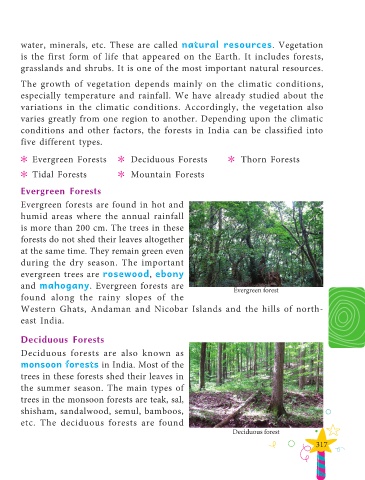
        Evergreen Forests

        Evergreen forests are found in hot and
        humid areas where the annual rainfall

        is more than 200 cm. The trees in these
        forests do not shed their leaves altogether

        at the same time. They remain green even
        during  the  dry  season.  The  important

        evergreen trees are rosewood, ebony
        and mahogany. Evergreen forests are                                       Evergreen forest

        found along the rainy slopes of the
        Western Ghats, Andaman and Nicobar Islands and  the hills of  north-

        east India.


        Deciduous Forests

        Deciduous forests are also known as
        monsoon forests in India. Most of the

        trees in these forests shed their leaves in
        the summer season. The main types of

        trees in the monsoon forests are teak, sal,
        shisham, sandalwood, semul, bamboos,

        etc. The deciduous forests are found
                                                                                 Deciduous forest

                                                                                                              317

