


Page 294 - New Medley 4 Semester 1
P. 294
The Great Indian Desert is drained by a number of short seasonal streams.

               Luni is the only river, which flows through the desert. It is also a seasonal
               river.


               At some places in the desert areas, the underground water comes to the
               surface. These are called  oases. These are permanent sources of water.

               The land is fertile and people settle down around oases.

               The Great Indian Desert remains very hot during the daytime and cool

               at night. Most of the desert areas do not receive rainfall for many years.
               Trees cannot grow in such climatic conditions. Only plants with thorns

               and long roots can exist in very hot and dry climate.

               The shortage of water is the main problem  in  the  Great  Indian Desert.

               Even for cooking food, the women bring water
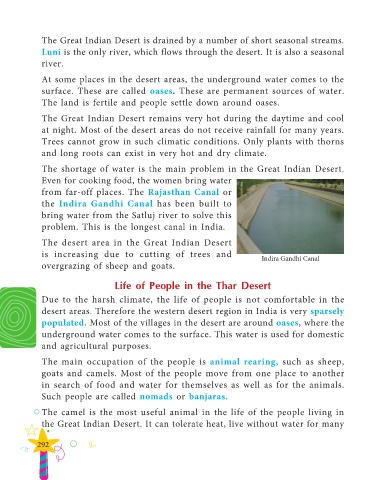
               from far-off places. The  Rajasthan Canal  or
               the  Indira Gandhi Canal has been built to

               bring water from the Satluj river to solve this

               problem. This is the longest canal in India.

               The desert area in the Great Indian Desert

               is  increasing  due  to  cutting  of  trees  and                            Indira Gandhi Canal
               overgrazing of sheep and goats.


                                         Life of People in the Thar Desert

               Due to the harsh climate, the life of people is not comfortable in the

               desert areas. Therefore the western desert region in India is very sparsely
               populated. Most of the villages in the desert are around oases, where the

               underground water comes to the surface. This water is used for domestic
               and agricultural purposes.


               The main occupation of the people is  animal rearing,  such as sheep,
               goats and camels. Most of the people move from one place to another

               in search of food and water for themselves as well as for the animals.
               Such people are called  nomads or  banjaras.


               The camel is the most useful animal in the life of the people living in
               the Great Indian Desert. It can tolerate heat, live without water for many


              292

