


Page 270 - New Medley 4 Semester 1
P. 270
DIGESTION OF FOOD

               We all eat food. Food gives us energy and protects us against

               diseases.  This  energy  comes  from  the  food  after  its  digestion.
               Digestion is a process by which the food is broken down into a

               simpler form.
               Let us understand the process of digestion.

               Teeth play an important role in the digestion

               of food because digestion begins in the mouth
               with the chewing of food. During the chewing,
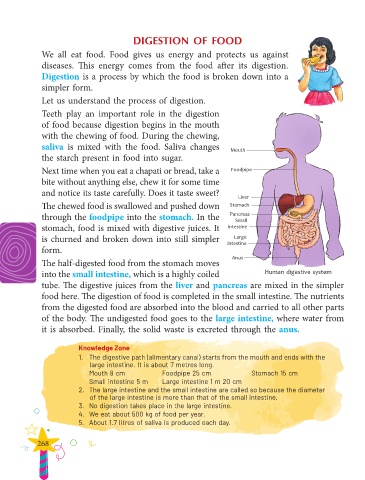
               saliva is mixed with the food. Saliva changes                     Mouth

               the starch present in food into sugar.

               Next time when you eat a chapati or bread, take a                 Foodpipe
               bite without anything else, chew it for some time
               and notice its taste carefully. Does it taste sweet?
                                                                                   Liver
               The chewed food is swallowed and pushed down                     Stomach

               through the foodpipe into the stomach. In the                    Pancreas
                                                                                  Small
               stomach, food is mixed with digestive juices. It                 intestine
               is churned and broken down into still simpler                    intestine
                                                                                  Large
               form.
               The half-digested food from the stomach moves                     Anus

               into the small intestine, which is a highly coiled                           Human digestive system
               tube. The digestive juices from the liver and pancreas are mixed in the simpler
               food here. The digestion of food is completed in the small intestine. The nutrients

               from the digested food are absorbed into the blood and carried to all other parts
               of the body. The undigested food goes to the large intestine, where water from

               it is absorbed. Finally, the solid waste is excreted through the anus.


                            Knowledge Zone
                            1.  The digestive path (alimentary canal) starts from the mouth and ends with the
                                large intestine. It is about 7 metres long.
                                Mouth 8 cm               Foodpipe 25 cm                 Stomach 15 cm
                                Small intestine 5 m      Large intestine 1 m 20 cm
                            2.  The large intestine and the small intestine are called so because the diameter
                                of the large intestine is more than that of the small intestine.
                            3.  No digestion takes place in the large intestine.
                            4.  We eat about 500 kg of food per year.
                            5.  About 1.7 litres of saliva is produced each day.


              268

