


Page 267 - New Medley 4 Semester 1
P. 267
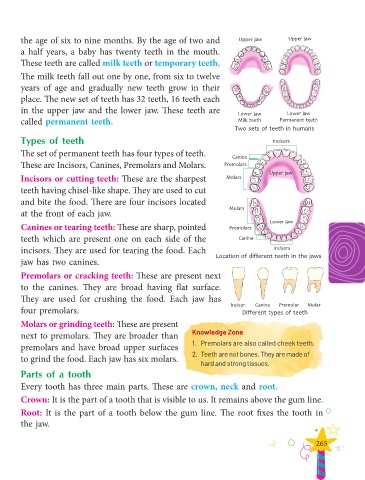
the age of six to nine months. By the age of two and                       Upper jaw         Upper jaw

        a half years, a baby has twenty teeth in the mouth.
        These teeth are called milk teeth or temporary teeth.

        The milk teeth fall out one by one, from six to twelve

        years of age and gradually new teeth grow in their
        place. The new set of teeth has 32 teeth, 16 teeth each
        in the upper jaw and the lower jaw. These teeth are                        Lower jaw        Lower jaw

        called permanent teeth.                                                    Milk teeth     Permanent teeth
                                                                                  Two sets of teeth in humans
        Types of teeth                                                                         Incisors

        The set of permanent teeth has four types of teeth.                      Canine
        These are Incisors, Canines, Premolars and Molars.                    Premolars

        Incisors or cutting teeth: These are the sharpest                      Molars         Upper jaw

        teeth having chisel-like shape. They are used to cut
        and bite the food. There are four incisors located

        at the front of each jaw.                                               Molars

        Canines or tearing teeth: These are sharp, pointed                      Premolars     Lower jaw
        teeth which are present one on each side of the                            Canine

        incisors. They are used for tearing the food. Each                                     Incisors
        jaw has two canines.                                               Location of different teeth in the jaws

        Premolars or cracking teeth: These are present next

        to the canines. They are broad having flat surface.
        They are used for crushing the food. Each jaw has

        four premolars.                                                          Incisor  Canine  Premolar  Molar
                                                                                     Different types of teeth
        Molars or grinding teeth: These are present

        next to premolars. They are broader than                   Knowledge Zone

        premolars and have broad upper surfaces                    1.  Premolars are also called cheek teeth.
        to grind the food. Each jaw has six molars.                2.   Teeth are not bones. They are made of
                                                                      hard and strong tissues.
        Parts of a tooth

        Every tooth has three main parts. These are crown, neck and root.

        Crown: It is the part of a tooth that is visible to us. It remains above the gum line.

        Root: It is the part of a tooth below the gum line. The root fixes the tooth in
        the jaw.


                                                                                                              265

