


Page 89 - New Medley 3 Semester 2
P. 89
LIFE SKILLS                                • Leadership and Initiative


        When  your  parents/elders  buy  things  of  daily  need  from  a  supermarket  or  a
        shop, they get a bill. A bill or a cash memo has the details of items, their rate

        per  unit  and  total  cost  of  each  item  and  finally  the  amount  we  have  to  pay.
        We must take a bill because it helps us in getting replacement of the thing or

        cash back for defective goods.

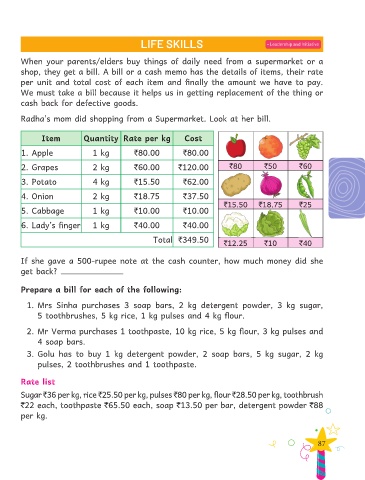
        Radha’s mom did shopping from a Supermarket. Look at her bill.


               Item           Quantity Rate per kg               Cost

        1. Apple                 1 kg          `80.00           `80.00


        2. Grapes                2 kg          `60.00          `120.00          `80         `50         `60

        3. Potato                4 kg          `15.50           `62.00

        4. Onion                 2 kg          `18.75           `37.50
                                                                              `15.50      `18.75        `25
        5. Cabbage               1 kg          `10.00           `10.00


        6. Lady’s finger         1 kg          `40.00           `40.00
                                                      Total `349.50
                                                                              `12.25        `10         `40


        If she gave a  500-rupee  note  at  the  cash  counter,  how  much  money  did she
        get back?


        Prepare a bill for each of the following:

          1.  Mrs Sinha purchases 3 soap bars, 2 kg detergent powder, 3 kg sugar,


              5 toothbrushes, 5 kg rice, 1 kg pulses and 4 kg flour.
          2.  Mr Verma purchases 1 toothpaste, 10 kg rice, 5 kg flour, 3 kg pulses and

              4 soap bars.

          3.  Golu  has  to  buy  1 kg detergent  powder,  2 soap bars,  5 kg  sugar,  2 kg
              pulses, 2 toothbrushes and 1 toothpaste.


        Rate list
        Sugar `36 per kg, rice `25.50 per kg, pulses `80 per kg, flour `28.50 per kg, toothbrush

        `22 each, toothpaste `65.50 each, soap `13.50 per bar, detergent powder `88
        per kg.


                                                                                                               87

