


Page 214 - New Medley 3 Semester 2
P. 214
STEM ACTIVITY 4
Growing seeds in di erent types of soil
Take three separate pots.
Fill each pot with a di erent type of soil:
Pot 1: Sand
Pot 2: Clay
Pot 3: Loam
Sow a few bean seeds in each of the three pots.
Water all the pots daily in equal amounts. sand
A er 10 days, observe the growth of the seeds in each pot.
Notice the following results:
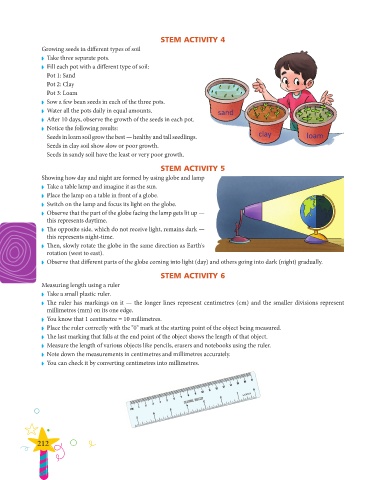
Seeds in loam soil grow the best — healthy and tall seedlings. clay loam
Seeds in clay soil show slow or poor growth.
Seeds in sandy soil have the least or very poor growth.
STEM ACTIVITY 5
Showing how day and night are formed by using globe and lamp
Take a table lamp and imagine it as the sun.
Place the lamp on a table in front of a globe.
Switch on the lamp and focus its light on the globe.
Observe that the part of the globe facing the lamp gets lit up —
this represents daytime.
e opposite side, which do not receive light, remains dark —
this represents night-time.
en, slowly rotate the globe in the same direction as Earth's
rotation (west to east).
Observe that di erent parts of the globe coming into light (day) and others going into dark (night) gradually.
STEM ACTIVITY 6
Measuring length using a ruler
Take a small plastic ruler.
e ruler has markings on it — the longer lines represent centimetres (cm) and the smaller divisions represent
millimetres (mm) on its one edge.
You know that 1 centimetre = 10 millimetres.
Place the ruler correctly with the "0" mark at the starting point of the object being measured.
e last marking that falls at the end point of the object shows the length of that object.
Measure the length of various objects like pencils, erasers and notebooks using the ruler.
Note down the measurements in centimetres and millimetres accurately.
You can check it by converting centimetres into millimetres.
212

