


Page 185 - New Medley 3 Semester 2
P. 185
When such changes take place very o en, the rocks get cracked. Too many

        cracks result in breaking the rocks into small pieces.  e process of breaking
        up of rocks goes on, over and over again, until the pieces of rocks turn into


        very  ne particles. A collection of such  ne particles is called soil.  e roots of
        plants also help in breaking the rocks. Breaking of di erent types of rocks gives

        di erent types of soil.

        Types of Soil

        Soil  di ers in  the size  of its grains  or particles

        and the minerals it contains. Di erent types of

        soil have di erent minerals present in them. Soils

        are given names on the basis of how much sand,

        silt and clay are present in them.


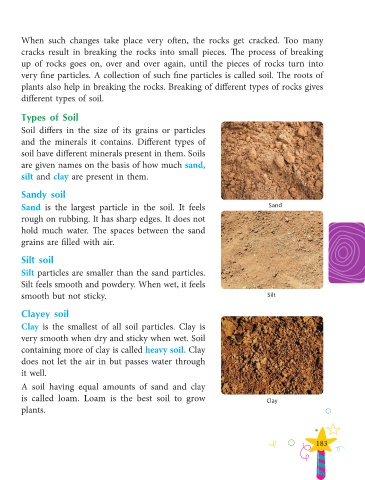
        Sandy soil
        Sand is the largest particle in the soil. It feels                                    Sand

        rough on rubbing. It has sharp edges. It does not

        hold much water.  e spaces between the sand

        grains are  lled with air.

        Silt soil

        Silt particles are smaller than the sand particles.
        Silt feels smooth and powdery. When wet, it feels
        smooth but not sticky.                                                               Silt


        Clayey soil

        Clay is the smallest of all soil particles. Clay is

        very smooth when dry and sticky when wet. Soil
        containing more of clay is called heavy soil. Clay

        does not let the air in but passes water through
        it well.

        A soil having equal amounts of sand and clay
        is called loam. Loam is the best soil to grow                                        Clay

        plants.


                                                                                                              183

