


Page 196 - New Medley 3 Semester 1
P. 196
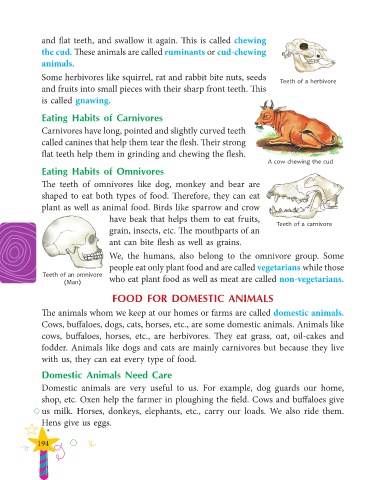
and  at teeth, and swallow it again.  is is called chewing


               the cud.  ese animals are called ruminants or cud-chewing

               animals.

               Some herbivores like squirrel, rat and rabbit bite nuts, seeds                     Teeth of a herbivore


               and fruits into small pieces with their sharp front teeth.  is
               is called gnawing.


               Eating Habits of Carnivores

               Carnivores have long, pointed and slightly curved teeth


               called canines that help them tear the  esh.  eir strong
                at teeth help them in grinding and chewing the  esh.


                                                                                              A cow chewing the cud
               Eating Habits of Omnivores

                e  teeth of omnivores  like  dog, monkey  and bear  are
               shaped to eat both types of food.  erefore, they can eat

               plant as well as animal food. Birds like sparrow and crow

                                       have beak that helps them to eat fruits,                  Teeth of a carnivore
                                       grain, insects, etc.  e mouthparts of an


                                       ant can bite  esh as well as grains.
                                       We, the humans, also belong to the omnivore group. Some
                                       people eat only plant food and are called vegetarians while those
                Teeth of an omnivore   who eat plant food as well as meat are called non-vegetarians.
                       (Man)

                                        FOOD FOR DOMESTIC ANIMALS

                e animals whom we keep at our homes or farms are called domestic animals.

               Cows, bu aloes, dogs, cats, horses, etc., are some domestic animals. Animals like

               cows,  bu aloes,  horses,  etc.,  are  herbivores.   ey  eat  grass,  oat,  oil-cakes  and


               fodder. Animals like dogs and cats are mainly carnivores but because they live
               with us, they can eat every type of food.


               Domestic Animals Need Care
               Domestic animals are very useful to us. For example, dog guards our home,


               shop, etc. Oxen help the farmer in ploughing the  eld. Cows and bu aloes give
               us milk. Horses, donkeys, elephants, etc., carry our loads. We also ride them.
               Hens give us eggs.


              194

