


Page 104 - New Medley 5 Semester 2
P. 104
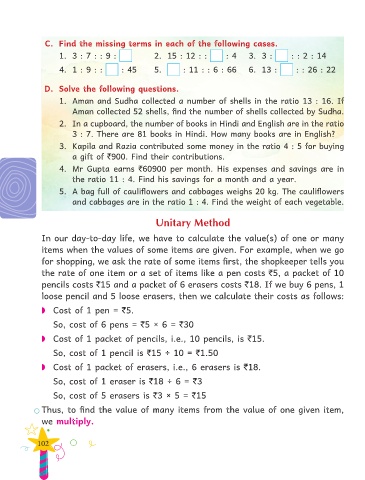
C. Find the missing terms in each of the following cases.
1. 3 : 7 : : 9 : 2. 15 : 12 : : : 4 3. 3 : : : 2 : 14
4. 1 : 9 : : : 45 5. : 11 : : 6 : 66 6. 13 : : : 26 : 22
D. Solve the following questions.
1. Aman and Sudha collected a number of shells in the ratio 13 : 16. If
Aman collected 52 shells, find the number of shells collected by Sudha.
2. In a cupboard, the number of books in Hindi and English are in the ratio
3 : 7. There are 81 books in Hindi. How many books are in English?
3. Kapila and Razia contributed some money in the ratio 4 : 5 for buying
a gift of `900. Find their contributions.
4. Mr Gupta earns `60900 per month. His expenses and savings are in
the ratio 11 : 4. Find his savings for a month and a year.
5. A bag full of cauliflowers and cabbages weighs 20 kg. The cauliflowers
and cabbages are in the ratio 1 : 4. Find the weight of each vegetable.
Unitary Method
In our day-to-day life, we have to calculate the value(s) of one or many
items when the values of some items are given. For example, when we go
for shopping, we ask the rate of some items first, the shopkeeper tells you
the rate of one item or a set of items like a pen costs `5, a packet of 10
pencils costs `15 and a packet of 6 erasers costs `18. If we buy 6 pens, 1
loose pencil and 5 loose erasers, then we calculate their costs as follows:
Cost of 1 pen = `5.
So, cost of 6 pens = `5 × 6 = `30
Cost of 1 packet of pencils, i.e., 10 pencils, is `15.
So, cost of 1 pencil is `15 ÷ 10 = `1.50
Cost of 1 packet of erasers, i.e., 6 erasers is `18.
So, cost of 1 eraser is `18 ÷ 6 = `3
So, cost of 5 erasers is `3 × 5 = `15
Thus, to find the value of many items from the value of one given item,
we multiply.
102

