


Page 7 - New Medley 5 Semester 1
P. 7
CG-3
             Understands       C-3.1  Measures using non-standard and standard units and recognises and appreciates the need for
             measurable attributes   standard units.
             of objects and the   C-3.2  Uses an appropriate unit and tool for the attribute being measured.
             units, systems, and   C-3.3  Carries out simple unit conversions, such as from centimetres to metres, within a system of
             processes of such       measurement and solves daily life problems.
             measurement,      C-3.4  Devises strategies for estimating the distance, length, time, perimeter (for regular and irregular
             including those         shapes), area (for regular and irregular shapes), weight and volume.
             related to distance,   C-3.5  Deduces that shapes having equal areas can have different perimeters and shapes having equal
             length, mass, weight,   perimeters can have different areas.
             area, volume,     C-3.6  Measures  distance,  length,  perimeter,  time,  weight,  area,  and  volume  and  to  solve  daily  life
             and time, using         problems.
             non-standard and
             standard units.
             CG-4
             Develops problem-
             solving skills with
             procedural fluency, to
             solve mathematical   C-4.1  Solves puzzles and daily life problems involving one or more operations on whole numbers.
             puzzles as well as   C-4.2  Selects appropriate methods and tools for computing with whole numbers such as mental
             daily life problems,    computation, estimation, or paper and pencil calculation, in accordance with the context.
             and as a step
             towards developing
             computational
             thinking
             CG-5
             Knows and         C-5.1  Understands the development of the representation of numbers through human history, from tallying
             appreciates the         (e.g., on the Lebombo bones), to Roman numerals, to the Mayan and Babylonian systems, leading
             development of          up to the development of zero in India and the modern Indian system of writing numerals (from
             numeration through      Yajurveda, story of Buddha, Bakshali Manuscript, Vasavadatta, Aryabhatiya, Brahmasphutasiddanta,
             human history           Gwalior inscription, etc.) and its transmission to the world (due to Al-Kharizmi, Al-Kindi, Fibonacci,
             including the major     etc.).
             contributions of India.


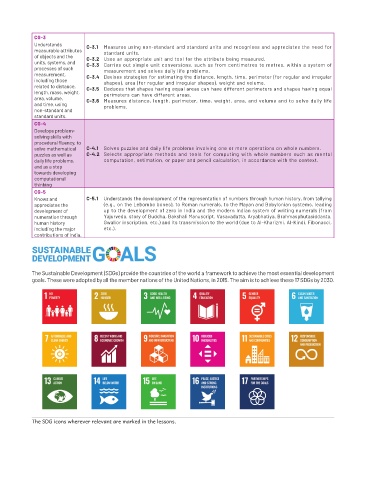
            The Sustainable Development (SDGs) provide the countries of the world a framework to achieve the most essential development
            goals. These were adopted by all the member nations of the United Nations, in 2015. The aim is to achieve these 17 SDGs by 2030.


            The SDG icons wherever relevant are marked in the lessons.

