


Page 211 - New Medley 5 Semester 1
P. 211
Using short-cut method
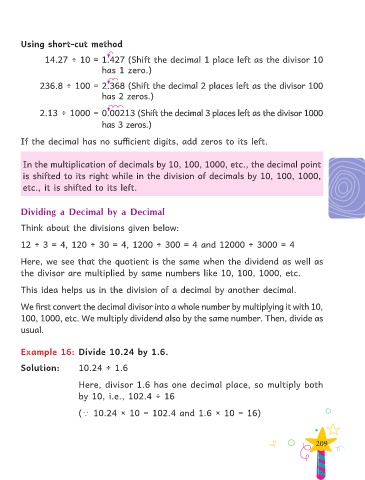
14.27 ÷ 10 = 1.427 (Shift the decimal 1 place left as the divisor 10
has 1 zero.)
236.8 ÷ 100 = 2.368 (Shift the decimal 2 places left as the divisor 100
has 2 zeros.)
2.13 ÷ 1000 = 0.00213 (Shift the decimal 3 places left as the divisor 1000
has 3 zeros.)
If the decimal has no sufficient digits, add zeros to its left.
In the multiplication of decimals by 10, 100, 1000, etc., the decimal point
is shifted to its right while in the division of decimals by 10, 100, 1000,
etc., it is shifted to its left.
Dividing a Decimal by a Decimal
Think about the divisions given below:
12 ÷ 3 = 4, 120 ÷ 30 = 4, 1200 ÷ 300 = 4 and 12000 ÷ 3000 = 4
Here, we see that the quotient is the same when the dividend as well as
the divisor are multiplied by same numbers like 10, 100, 1000, etc.
This idea helps us in the division of a decimal by another decimal.
We first convert the decimal divisor into a whole number by multiplying it with 10,
100, 1000, etc. We multiply dividend also by the same number. Then, divide as
usual.
Example 16: Divide 10.24 by 1.6.
Solution: 10.24 ÷ 1.6
Here, divisor 1.6 has one decimal place, so multiply both
by 10, i.e., 102.4 ÷ 16
( 10.24 × 10 = 102.4 and 1.6 × 10 = 16)
209

