


Page 175 - New Medley 5 Semester 1
P. 175
1 2 3              5
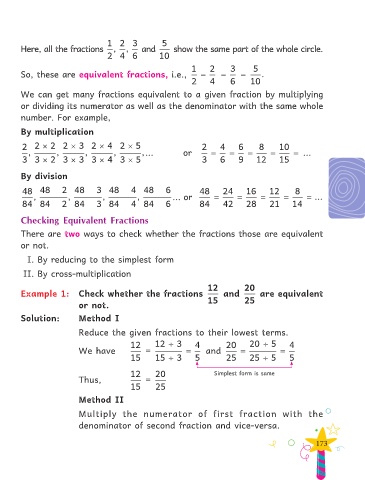
        Here, all the fractions  ,           ,    and        show the same part of the whole circle.
                                      2 4 6             10

                                                                   1     2       3      5
        So, these are equivalent fractions, i.e.,                     =      =      =      .
                                                                   2     4       6     10


        We  can  get  many  fractions  equivalent  to  a  given  fraction  by  multiplying
        or dividing its numerator as well as the denominator with the same whole

        number. For example,

        By multiplication

         2 ,  2 ×  2 2 ×    3 2 ×     4 2 ×     5                      2  =  4  =  6   =  8   =  10
                     ,
                                        ,
                              ,
         3 3 ×    2 3 ×     3 3 ×     4 3 ×     5 ,...       or        3     6     9     12      15   = ...
        By division

         48    48 ÷   2 48 ÷      3 48 ÷      4 48 ÷      6           48      24      16      12       8
             ,          ,           ,           ,            ... or        =       =       =       =       = ...
         84 84 ÷      2 84 ÷      3 84 ÷      4 84 ÷      6           84      42      28      21      14

        Checking Equivalent Fractions


        There are two ways to check whether the fractions those are equivalent
        or not.

          I. By reducing to the simplest form

         II. By cross-multiplication

                                                                         12          20
        Example 1:  Check whether the fractions                               and          are equivalent
                                                                         15          25
                            or not.

        Solution:           Method I

                            Reduce the given fractions to their lowest terms.
                                              12       12 ÷   3     4          20      20 ÷    5     4
                            We have                =             =      and         =             =
                                              15       15 ÷   3     5          25      25 ÷    5     5


                                              12       20                  Simplest form is same
                            Thus,                  =
                                              15       25


                            Method II

                            Multiply  the  numerator  of  first  fraction  with  the
                            denominator of second fraction and vice-versa.

                                                                                                              173

