


Page 298 - New Medley 4 Semester 2 PDF (Merged)
P. 298
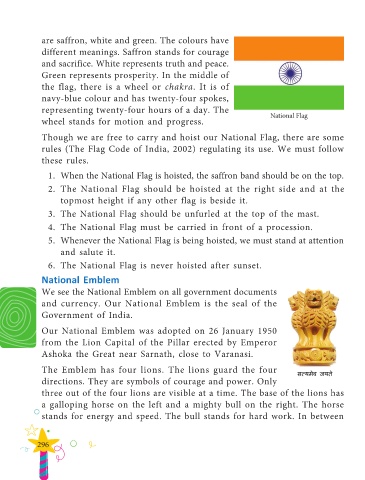
are saffron, white and green. The colours have

               different meanings. Saffron stands for courage
               and sacrifice. White represents truth and peace.

               Green represents prosperity. In the middle of
               the flag, there is a wheel or  chakra. It is of

               navy-blue colour and has twenty-four spokes,
               representing twenty-four hours of a day. The                                   National Flag

               wheel stands for motion and progress.

               Though we are free to carry and hoist our National Flag, there are some

               rules (The Flag Code of India, 2002) regulating its use. We must follow
               these rules.

                 1.  When the National Flag is hoisted, the saffron band should be on the top.

                 2.  The National Flag should be hoisted at the right side and at the

                      topmost height if any other flag is beside it.

                 3.  The National Flag should be unfurled at the top of the mast.

                 4.  The National Flag must be carried in front of a procession.
                 5.  Whenever the National Flag is being hoisted, we must stand at attention

                      and salute it.

                 6.  The National Flag is never hoisted after sunset.

               National Emblem

               We see the National Emblem on all government documents
               and currency. Our National Emblem is the seal of the

               Government of India.

               Our  National  Emblem was  adopted  on  26  January  1950
               from the Lion Capital of the Pillar erected by Emperor

               Ashoka the Great near Sarnath, close to Varanasi.

               The Emblem has four lions. The lions guard the four

               directions. They are symbols of courage and power. Only
               three out of the four lions are visible at a time. The base of the lions has

               a galloping horse on the left and a mighty bull on the right. The horse
               stands for energy and speed. The bull stands for hard work. In between


              296

