


Page 282 - New Medley 4 Semester 1
P. 282
The Greater Himalayas (Himadri)

               The Himadri ranges are located in  the extreme northern part of the

               Himalayan mountain ranges. These mountain ranges remain covered with
               snow almost throughout the year. There are many peaks in the Himadri

               which are more than 8000 metres high. Mt Kanchenjunga, about 8,598
               metres high, is the highest peak in the Greater Himalayas. Many glaciers

               originate in these mountains. Many rivers, such as the Ganga and the
               Yamuna, originate from here.


               The Lesser Himalayas (Himachal)

               The Lesser Himalayas or the Himachal

               ranges are towards the south of the
               Himadri ranges. The Himadri and

               the Himachal are separated by deep
               river valleys. These mountain ranges

               receive regular snowfall during the
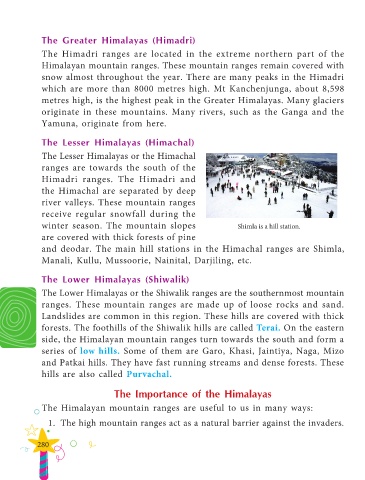
               winter season. The mountain slopes                                  Shimla is a hill station.

               are covered with thick forests of pine
               and deodar. The main hill stations in the Himachal ranges are Shimla,

               Manali, Kullu, Mussoorie, Nainital, Darjiling, etc.


               The Lower Himalayas (Shiwalik)

               The Lower Himalayas or the Shiwalik ranges are the southernmost mountain
               ranges. These mountain ranges are made up of loose rocks and sand.

               Landslides are common in this region. These hills are covered with thick
               forests. The foothills of the Shiwalik hills are called Terai. On the eastern

               side, the Himalayan mountain ranges turn towards the south and form a
               series of  low hills. Some of them are Garo, Khasi, Jaintiya, Naga, Mizo

               and Patkai hills. They have fast running streams and dense forests. These
               hills are also called  Purvachal.


                                        The Importance of the Himalayas

               The Himalayan mountain ranges are useful to us in many ways:

                 1.  The high mountain ranges act as a natural barrier against the invaders.


              280

