


Page 207 - New Medley 3 Semester 2
P. 207
MEASURING CAPACITY


         e amount of a liquid that a container can hold

        is called its  capacity.  e liquid things which

        we use in our day-to-day life, come in di erent
        capacities. A large bottle of cold drink carries
        2 litres of drink.  e common milk pouches

        available in the market contain 1 litre or half
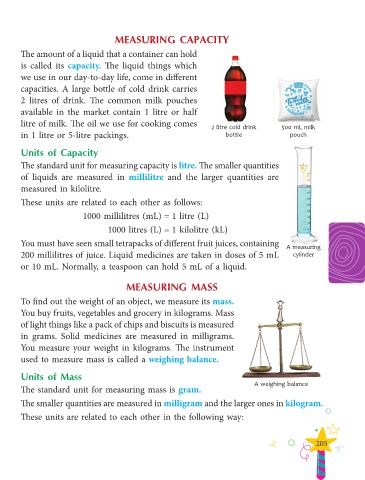
        litre of milk.  e oil we use for cooking comes                    2 litre cold drink      500 mL milk

        in 1 litre or 5-litre packings.                                        bottle                pouch


        Units of Capacity


         e standard unit for measuring capacity is litre.  e smaller quantities
        of liquids are measured in  millilitre and the larger quantities are
        measured in kilolitre.

         ese units are related to each other as follows:

                              1000 millilitres (mL) = 1 litre (L)

                                      1000 litres (L) = 1 kilolitre (kL)


        You must have seen small tetrapacks of di erent fruit juices, containing                    A measuring
        200 millilitres of juice. Liquid medicines are taken in doses of 5 mL                         cylinder
        or 10 mL. Normally, a teaspoon can hold 5 mL of a liquid.


                                             MEASURING MASS


        To  nd out the weight of an object, we measure its mass.

        You buy fruits, vegetables and grocery in kilograms. Mass

        of light things like a pack of chips and biscuits is measured
        in  grams.  Solid  medicines  are  measured  in  milligrams.


        You measure your weight in kilograms.  e instrument
        used to measure mass is called a weighing balance.


        Units of Mass

         e standard unit for measuring mass is gram.                                     A weighing balance

         e smaller quantities are measured in milligram and the larger ones in kilogram.


         ese units are related to each other in the following way:


                                                                                                              205

