


Page 305 - New Medley 5 Semester 2
P. 305
Non-Cooperation Movement

        People in every part of India were very angry about the cruel attitude
        of British rulers. Gandhiji launched the Non-Cooperation Movement

        in 1920. Some people in  Chauri Chaura  set the police station on fire.
        Gandhiji withdrew the Non-Cooperation Movement immediately.


        During the movement many Congress leaders, such as Rajendra Prasad,
        Sardar Patel, Sarojini Naidu, Rajagopalachari, Jawaharlal Nehru, Maulana

        Azad and others were arrested. Many Congressmen wanted to use force
        against the British. But Gandhiji strictly objected to it.

        In 1929, the Indian National Congress resolved to achieve Purna Swaraj,

        and  26 January 1930 was celebrated as the  Independence Day.  People

        participated in the Satyagraha Movement and boycotted foreign goods,
        stopped paying taxes, etc.


        Civil Disobedience Movement

        During this movement, Gandhiji led the Dandi March and broke the salt laws.

        Gandhiji asked the people to boycott foreign goods. Thus, Khadi became

        the dress of Indian freedom fighters. This benefitted the Indian weavers.
        The  Second World War started in 1939. The British forced Indians to

        take part in the war, without talking to the leaders. People disliked the
        policy of the British rulers and demanded complete freedom. The British

        government refused to consider it.

        Quit India Movement

        Congress launched the Quit India

        Movement in 1942. Gandhiji asked
        the  people  to  ‘Do or Die’.  Many

        leaders were arrested.

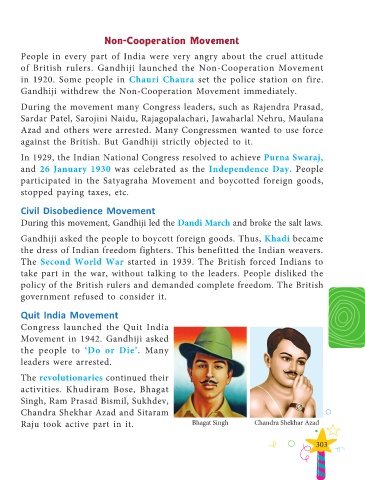
        The revolutionaries continued their

        activities.  Khudiram  Bose, Bhagat
        Singh, Ram Prasad Bismil, Sukhdev,

        Chandra Shekhar Azad and Sitaram
        Raju took active part in it.                               Bhagat Singh          Chandra Shekhar Azad


                                                                                                              303

