


Page 217 - New Medley 5 Semester 2
P. 217
Igneous rocks
Igneous rocks are also called the re rocks. ere are molten rocks called magma
present deep under the earth. When this magma gets trapped in small spaces or
pockets and cools down slowly, it forms igneous rocks.
When magma comes above the ground during volcanic eruptions, it is called
lava. On cooling, lava forms igneous rocks.
us, igneous rocks are formed either underground by magma or on the surface
of the ground by lava.
ere are many kinds of igneous rocks. Each kind of igneous rocks contains
di erent minerals and has a di erent structure. e various kinds of igneous
rocks are as follows:
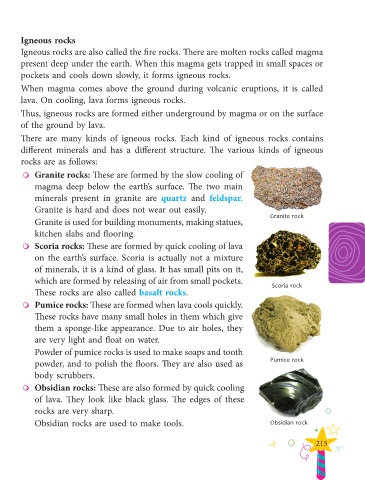
Granite rocks: ese are formed by the slow cooling of
magma deep below the earth’s surface. e two main
minerals present in granite are quartz and feldspar.
Granite is hard and does not wear out easily.
Granite is used for building monuments, making statues, Granite rock
kitchen slabs and ooring.
Scoria rocks: ese are formed by quick cooling of lava
on the earth’s surface. Scoria is actually not a mixture
of minerals, it is a kind of glass. It has small pits on it,
which are formed by releasing of air from small pockets. Scoria rock
ese rocks are also called basalt rocks.
Pumice rocks: ese are formed when lava cools quickly.
ese rocks have many small holes in them which give
them a sponge-like appearance. Due to air holes, they
are very light and oat on water.
Powder of pumice rocks is used to make soaps and tooth
powder, and to polish the oors. ey are also used as Pumice rock
body scrubbers.
Obsidian rocks: ese are also formed by quick cooling
of lava. ey look like black glass. e edges of these
rocks are very sharp.
Obsidian rocks are used to make tools. Obsidian rock
215

