


Page 229 - New Medley 4 Semester 2 PDF (Merged)
P. 229
From the above activities, we conclude that:

            Land gets heated up faster than water. Also, land loses heat faster than water

             and so it becomes cool earlier.

            Air expands on heating, becomes lighter and rises up.

        These features of air, water and land explain some interesting weather conditions.

        Formation of sea breeze

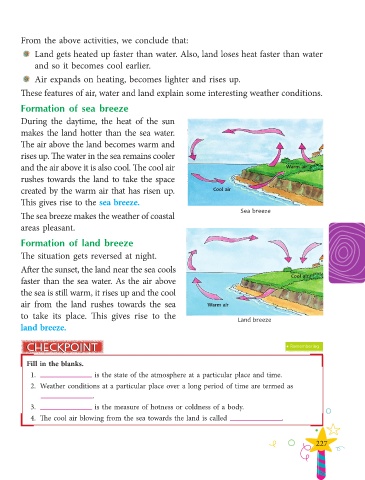
        During the daytime, the heat of the sun
        makes the land hotter than the sea water.

        The air above the land becomes warm and
        rises up. The water in the sea remains cooler

        and the air above it is also cool. The cool air                                             Warm air
        rushes towards the land to take the space

        created by the warm air that has risen up.                         Cool air
        This gives rise to the sea breeze.

        The sea breeze makes the weather of coastal                                 Sea breeze

        areas pleasant.

        Formation of land breeze

        The situation gets reversed at night.

        After the sunset, the land near the sea cools
        faster than the sea water. As the air above                                                   Cool air

        the sea is still warm, it rises up and the cool
        air from the land rushes towards the sea                         Warm air

        to take its place. This gives rise to the                                  Land breeze
        land breeze.


                                                                                                    • Remembering

          Fill in the blanks.

            1.                    is the state of the atmosphere at a particular place and time.
            2.  Weather conditions at a particular place over a long period of time are termed as
                                 .

            3.                    is the measure of hotness or coldness of a body.
            4.  The cool air blowing from the sea towards the land is called                      .


                                                                                                              227

