


Page 331 - New Medley 4 Semester 1
P. 331
The farmers need enough and timely supply of water for growing crops.

        To meet this need of the farmers, we must develop a proper  irrigation
        system.


        A major part of rain water flows into rivers. Some of it is collected in
        tanks and lakes. Some water seeps through the surface and gets collected

        under the ground. A very large part of the rain water flows into the seas
        or oceans.


        It is difficult to take water from the rivers directly to the fields. Thus
        small channels are dug and the river water is diverted in them. These

        are called  canals. The canals help in irrigation of the fields. The  canal
        irrigation system is mostly found in the Northern Plains of India and

        the delta region in the coastal areas.

        Dams  have  been  built  across  some  rivers  in  India.  They  can  create  an
        artificial lake behind the dam. Water is stored in such reservoirs or

        artificial lakes. Canals are built to take the water from the reservoirs to

        the fields. The dams also help in generating electricity. These projects
        are called  multipurpose river valley projects.


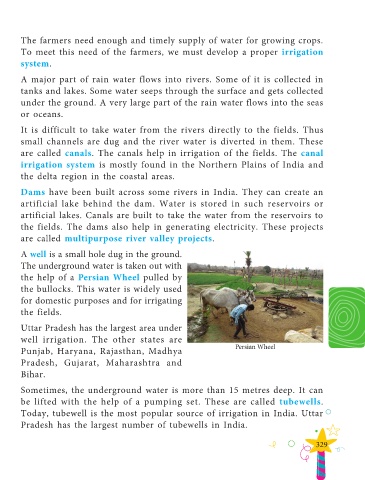
        A well is a small hole dug in the ground.
        The underground water is taken out with
        the help of a Persian Wheel pulled by

        the bullocks. This water is widely used

        for domestic purposes and for irrigating
        the fields.

        Uttar Pradesh has the largest area under

        well irrigation. The other states are
        Punjab, Haryana, Rajasthan, Madhya                                        Persian Wheel

        Pradesh,  Gujarat,  Maharashtra  and
        Bihar.


        Sometimes, the underground water is more than 15 metres deep. It can
        be lifted with the help of a pumping set. These are called  tubewells.

        Today, tubewell is the most popular source of irrigation in India. Uttar
        Pradesh has the largest number of tubewells in India.


                                                                                                              329

