


Page 72 - New Medley 3 Semester 1
P. 72
Think and Answer                                                                       •  Critical  Thinking
                                                                                                      •  Communication  Skills

               Discuss with your partner and write the answers on your own.


                 A. Do you think Buddy was a friendly dog? Give reasons to support your answer.

                 B. Do you think that Simi and her family were good neighbours? Give examples

                     to support your answer.


               Grammar Spot                                                                         •  Verbs
                                                                                                    •  Simple  present  tense
                                                                                                    •  Present  continuous  tense


                                                               Verbs

               Read these sentences.

                 1.   Simi plays with Buddy.

                 2.  “You all are wonderful neighbours,” said Mohit.


                 3. I am a student.

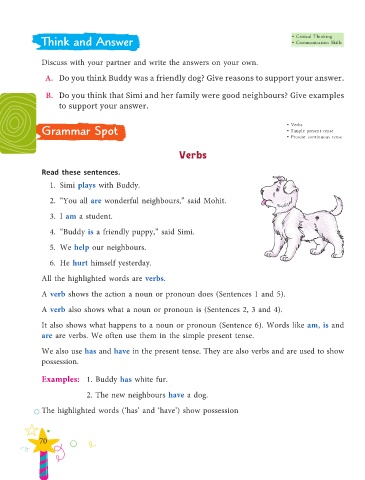
                 4. “Buddy is a friendly puppy,” said Simi.

                 5. We help our neighbours.


                 6. He hurt himself yesterday.

               All the highlighted words are verbs.

               A verb shows the action a noun or pronoun does (Sentences 1 and 5).


               A verb also shows what a noun or pronoun is (Sentences 2, 3 and 4).

               It also shows what happens to a noun or pronoun (Sentence 6). Words like am, is and
               are are verbs. We often use them in the simple present tense.

               We also use has and have in the present tense. They are also verbs and are used to show

               possession.


               Examples:  1. Buddy has white fur.

                               2. The new neighbours have a dog.

               The highlighted words (‘has’ and ‘have’) show possession


               70

