


Page 54 - New Medley 5 Semester 2
P. 54
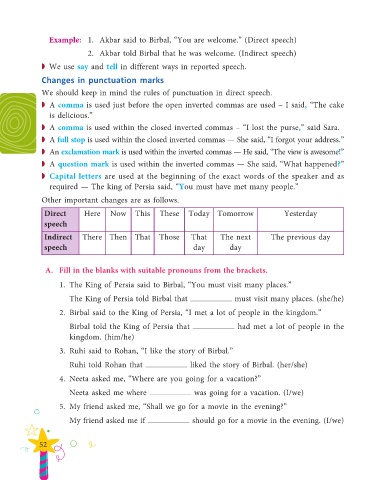
Example: 1. Akbar said to Birbal, “You are welcome.” (Direct speech)
2. Akbar told Birbal that he was welcome. (Indirect speech)
We use say and tell in different ways in reported speech.
Changes in punctuation marks
We should keep in mind the rules of punctuation in direct speech.
A comma is used just before the open inverted commas are used – I said, “The cake
is delicious.”
A comma is used within the closed inverted commas – “I lost the purse,” said Sara.
A full stop is used within the closed inverted commas — She said, “I forgot your address.”
An exclamation mark is used within the inverted commas — He said, “The view is awesome!”
A question mark is used within the inverted commas — She said, “What happened?”
Capital letters are used at the beginning of the exact words of the speaker and as
required — The king of Persia said, “You must have met many people.”
Other important changes are as follows.
Direct Here Now This These Today Tomorrow Yesterday
speech
Indirect There Then That Those That The next The previous day
speech day day
A. Fill in the blanks with suitable pronouns from the brackets.
1. The King of Persia said to Birbal, “You must visit many places.”
The King of Persia told Birbal that must visit many places. (she/he)
2. Birbal said to the King of Persia, “I met a lot of people in the kingdom.”
Birbal told the King of Persia that had met a lot of people in the
kingdom. (him/he)
3. Ruhi said to Rohan, “I like the story of Birbal.”
Ruhi told Rohan that liked the story of Birbal. (her/she)
4. Neeta asked me, “Where are you going for a vacation?”
Neeta asked me where was going for a vacation. (I/we)
5. My friend asked me, “Shall we go for a movie in the evening?”
My friend asked me if should go for a movie in the evening. (I/we)
52

