


Page 204 - New Medley 3 Semester 1
P. 204
1                                                               • Understanding


                 Answer in one word.
                 1.   ese feathers keep the bird warm.

                  2.   ese save the feathers of water birds from rotting.


                  3.   e shape of the body that birds have.


                                             EATING HABITS OF BIRDS
               Birds spend most of their time in search of food. Most birds are insectivorous


               or omnivorous. Some birds like eagle, hawk and owl are carnivorous.  ey are
               called birds of prey. Some birds like pigeon and hummingbird are herbivorous
               whereas birds like crow and sparrow are omnivorous.


                                                     BEAKS OF BIRDS


                e mouth of a bird is called the beak. It is also called bill.
               Birds use their beaks for eating, hunting, feeding young ones,

               gathering food and nesting materials, building nests, preening,

               scratching, attacking and  ghting with their enemies. Beaks
               are also used to drink, hold, pierce and tear food.


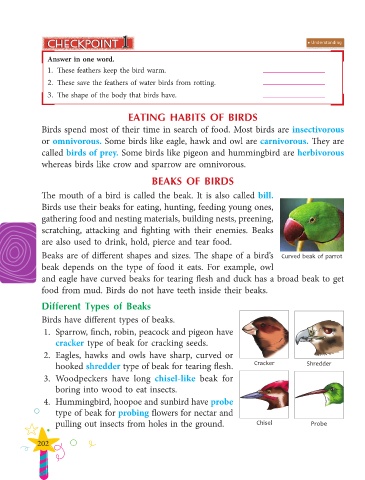
               Beaks are of di erent shapes and sizes.  e shape of a bird’s  Curved beak of parrot
               beak depends on the type of food it eats. For example, owl
               and eagle have curved beaks for tearing  esh and duck has a broad beak to get

               food from mud. Birds do not have teeth inside their beaks.


               Different Types of Beaks

               Birds have di erent types of beaks.


                1.  Sparrow,  nch, robin, peacock and pigeon have
                    cracker type of beak for cracking seeds.
                2.  Eagles, hawks  and  owls have sharp,  curved or


                    hooked shredder type of beak for tearing  esh.                       Cracker           Shredder
                3.   Woodpeckers have long chisel-like beak for

                    boring into wood to eat insects.
                4.  Hummingbird, hoopoe and sunbird have probe

                    type of beak for probing  owers for nectar and

                    pulling out insects from holes in the ground.                         Chisel            Probe


              202

